• Skip to primary navigation
  • Skip to main content

Sedona City Councilmember Pete Furman

  • Home
  • About Pete
    • Meet Pete
    • Pete’s Priorities
    • Pete’s Perspectives
  • In the News
  • City Meetings
    • Upcoming Sedona City Meetings
    • Sedona City Meeting Summaries
  • Contact Pete
  • Show Search
Hide Search

In the News

Sedona City Council decides against ESG investment strategy

Pete Furman · October 19, 2023 ·

Sedona City Council decides against ESG investment strategy – Sedona Red Rock News
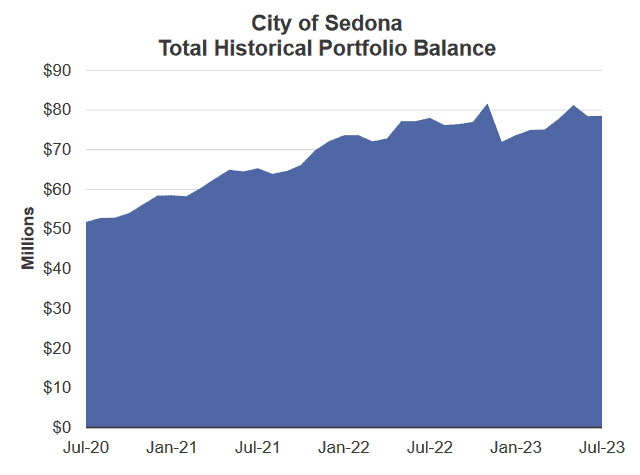
Growth in the city of Sedona’s portfolio balance over the last three years. The city recently declined to adjust its investment strategy to include ESG values. Photo courtesy city of Sedona.

The Sedona City Council reached a consensus not to expand its investment management services agreement with PFM Asset Management to include decision-making based on “environmental, social and governance” values during its meeting on Wednesday, Oct. 11.

Annette Gaston and Sarah Walsh of PFM were on hand to discuss the city’s current investment strategy as well as options for incorporating ESG planning into that strategy.

“The portfolio as it is now has a very liquid makeup, and that’s something we would look to keep intact,” Gaston said.

The city’s investment balance of $78,575,586 as of July 31 is divided three ways, with 24% in money market funds, 26% in government securities and 49% in the state’s Local Government Investment Pool. The LGIP is an investment fund managed by the Arizona state treasurer to provide local governments with greater yield through pooling their assets.

The portfolio’s annual growth rate over the last three years was 13.9%.

Environmental, Social and Governance

ESG investing is an approach to making investment decisions that takes into account not only a company’s financial performance, but also its performance on a range of environmental, social and governance measurement scales. Environmental performance is measured using factors such as carbon footprint, pollution levels and contributions to deforestation, while the social component is scored on factors including human rights and diversity and the governance contribution involves elements such as bribery, corruption and executive compensation.

A company’s ESG performance is commonly scored on a 1 to 100 scale that “measures economic value at risk based on ESG factors.” A lower score means less risk.

“ESG is really just another way of performing risk management,” Walsh said.

Involvement in either a given industry or a specific business activity can also be used as an exclusionary criterion to eliminate companies as potential investments. PFM’s examples of such activities included involvement in the production of oil, coal, alcohol and drugs, weapons, contraceptives and pesticides.

“Are the places to proactively invest also considered?” Councilwoman Kathy Kinsella asked. “That’s a missing component, perhaps.”

“It’s more of a taking away what they’re doing bad rather than rewarding what they’re doing right,” Walsh said.

PFM has 210 companies on its approved issuer list.

“If you were to implement the example approach that I just walked through,” Walsh told the council, an example that had focused on firms with medium or low ESG risk and excluded firms dealing in fossil fuels, tobacco, pharmaceuticals and forestry products, the number of companies with which the city could invest through PFM would drop to 173.

“Are you going to make investments so that the yield, regardless of categories we might choose, is the same?” Councilwoman Jessica Williamson asked. “There would be no yield consequence to ESG decisions?”

“That’s correct,” Walsh said. “That’s what we’ve observed in portfolios that we manage for other entities.”

“There is, in the rumor mill, in the general anti-ESG messaging, that you should expect lower yields,” Vice Mayor Holli Ploog said.

“That’s not what we’re observing,” Walsh said.

“My experience in ESG is that [those funds] sometimes tend to underperform,” Councilwoman Melissa Dunn said.

Banking Services

One of the examples included in the PFM presentation involved Wells Fargo, the city’s current provider of banking services, which led to additional questions from council.

“Did you compare Wells Fargo with banks of similar size?” Ploog asked with regard to Wells Fargo’s ESG score.

“I believe Wells Fargo is one of the worst-rated banks out there … but I would have to look at the banks themselves,” Walsh said, before adding that overall Wells Fargo’s ranking was “very poor.”

“What’s the best banks?” Mayor Scott Jablow asked.

“I would have to look,” Walsh said.

“I would also want council to consider our experience as an institution with Wells Fargo, which has been phenomenal,” City Manager Karen Osburn said.

City Finance Director Cherie White said that “it is a good thing to do a banking services RFP” from time to time to keep the bank on their toes, but agreed with Osburn about the benefits of the city’s current arrangement.

“It is a pretty significant undertaking to change all the banking services,” White said.

“I think it’s something we should look at,” Jablow said, but suggested it be considered at a later date.

“I don’t think we should be deciding on which bank our staff has had very, very good relations with,” Williamson said.

Vetting

“My mind says I have questions, but I can’t formulate them,” Williamson said. “What does staff think?”

“I’m OK either way,” White said. “I was one of the ones that was a little hesitant until talking with PFM staff and finding out this isn’t really going to impact our yields.”

“I had some of the same concerns,” Osburn said. “I do still have a few others … On the environmental side of things, we’ve done a very extensive job of going out to the community and asking them … what we haven’t done is any kind of vetting in terms of social values.”

“You feel very comfortable going down an E path, not an ESG path,” Williamson said to Osburn. “You feel confident that [environmental] values for the community have been fairly established and the other two have not been and I would agree with you.”

“It seems like those are less subjective,” Osburn said. “We can speak very clearly to the engagement of the community.”

“I think that if we went down that path on such a topic, it would come back, and rightfully so, to bite us,” Jablow said. “That has me concerned.”

“It’s not clear to me that now is the right time,” Councilman Pete Furman said. “It’s not our money, it’s other people’s money, and we have a duty, in my opinion, about how we treat that money.”

“That we don’t have input about the S and the G very much takes those off the table,” Fultz said. “The environment piece, I’m actually uncomfortable with that … there’s discrepancies about how environment is actually considered … That Apple has this shining E-score makes absolutely no sense to me.”

Furman also suggested that attempting to determine community values “opens the door to discourse that will not be beneficial to harmony in the community.”

“I have a fiduciary responsibility to this community as a whole,” Dunn said. “We need to maximize the yield for the community because that’s what we said we were going to do.”

“I’m completely confused about the definitions,” Ploog said. “It doesn’t seem like we should be making any changes right now … I’m resistant about corporate [investment] to begin with, without even applying an ESG factor.”

Ploog also pointed out that the city had a negative return on its investments in 2022. The city’s investment loss in fiscal year 2022 was $2,475,192.

“That would be related to the LGIP,” White said, describing it as an “unrealized loss” that the city will recoup “when the market turns around.”

“I’m more comfortable in the E area at this point,” Kinsella said.

“I had no idea what you were talking about,” Williamson said. “I don’t see how we could change our investment policy without having any idea what we’re doing … I don’t want to second-guess my investment people … I support just the E.”

“I’m not comfortable changing to the ESG for all the reasons my counterparts have stated,” Jablow said. “We should not move forward with that.”


Sedona City Council’s lack of transparency in picking our leaders is distressing

Pete Furman · October 15, 2023 ·

Sedona City Council’s lack of transparency in picking our leaders is distressing – Sedona Red Rock News

Transparency is the cornerstone of democracy. Transparency in government lets citizens and voters see what elected officials and their professional staff are up to, and whether they’re all being honest and forthright with the use of our public tax dollars.

Public transparency is what motivated military analyst Daniel Ellsberg to leak 43 volumes of the Pentagon Papers to The New York Times reporter Neil Sheehan in 1971.

Those documents made transparent the U.S. military’s analysis of the failing war in Vietnam, exposing the futility of a military action that cost the lives of 58,281 Americans and more than 3 million Vietnamese on both sides.

Edward Snowden’s “treason” and/or “whistle-blowing” made transparent the operations of the National Security Agency’s spying program, created by the USA PATRIOT Act that had allowed government officials to spy on everyday Americans to such a degree that even some tech­nicians working at NSA sites were reading their ex-girl­friends’ private emails.

Prism, according to National Security Agency whistleblower Edward Snowden’s leaked documents, is the biggest single contributor to the NSA’s intelligence reports. As a “downstream” program, it collects data from Google, Facebook, Apple and others, and allowed government data watchers to spy on Americans by reading their emails, viewing photos and vidoes, and searching content users thought was private.

U.S. Supreme Court Justice Louis Brandeis wrote in 1913, “Publicity is justly commended as a remedy for social and industrial diseases. Sunlight is said to be the best of disinfectants; electric light the most efficient policeman.”

We in the press celebrate Sunshine Week every September, when we honor those acts by journalists and other members of the public to obtain and release govern­ment documents that should be public but are being inap­propriately held back by governments or officials.

Arizona, for all its flaws and foibles, is an unusually trans­parent state when it comes to government. The architects of our state’s constitution included several protections not afforded to other states to avoid political abuse and public corruption, which lawmakers from both sides have been trying to claw back since the first legislature met in 1912.

Public documents and records are largely public in Arizona, including court and criminal records, which may surprise migrants from other states not used to way we Arizonans do things: Bluntly and openly.

Given all this above-board fair play here, it’s surprising and distressing that members of our Sedona City Council have chosen to keep secret and to hide from you, their voters, discussions about what they want to see in a replacement for City Manager Karen Osburn after she retires in the spring.

The argument from council members is that they don’t want potential applicants for the job seeing what council may be thinking about what they want in a city manager.

This argument is absurd.

First off, what the city wants is relatively simple: Someone who can do the job, run a staff of about 160 employees and be accountable to the public. If individual council members want to ask for more specific qualifications, then by all means, make those public. The last thing we want is some potential city manager to apply and waste the city’s time when their goals and skills are not aligned with the publicly-stated intentions of the current council.

Secondly, most residents would agree we would want a city manager who does their due diligence, possibly by watching these meetings and learning through the discus­sions what council wants in an employee.

Council members should be able to sniff out a fabulist and won’t hire one. Council’s fear on this issue reveals more about their own fears and failings than concern with the skill sets of a good self-salesman. If some council members fear they lack the people skills to avoid being easily hornswoggled by a good interviewer, then maybe those members of council shouldn’t be running our city.

Council had also promised to hold public interviews with the applicants for the city’s new Tourism Advisory Board. Council has now reversed course and held those meetings secretly, so we in the public don’t know what they asked about.

They say, again, that this might give unfair advantage to a potential board member. This argument only makes sense when several candidates compete for one position like a city manager and have no incentive to speak to each other. It doesn’t hold water when the discussion is for a mass of unpaid board appointments who will form factions on a board to get it to do what they want.

Certain candidates applied because they have agendas on what the city should do regarding tourism, so unless the candidates are going to be sequestered, there is nothing to prevent these candidates from giving their allies all the questions and council’s responses. This process simply means that independent board candidates — who council should be appointing — are at a disadvantage and we’ll be stuck, again, with the same faces presenting the same tired ideas to be rubber-stamped instead of a heterogeneous and dynamic group with new ideas.

We applaud Sedona City Councilman Pete Furman for arguing that the process should be more transparent, not less. The rest of council shouldn’t have anything to hide — unless they do — but without them meeting in public, we’ll never know what they may want to keep secret.

Yavapai County talks OHV use on public lands

Pete Furman · September 30, 2023 ·

Yavapai County talks OHV use on public lands – Sedona Red Rock News

The Yavapai County Board of Supervisors discussed what members said were negative effects of OHVs on rangeland in the Prescott and Coconino National Forests during the final part of the Yavapai Cattle Growers Association meeting held at the Yavapai County Administration Building in Cottonwood on Thursday, Sept. 7. 

“It’s been about two and a half years where we’ve developed language to have the legislature take a look at regarding the OHV violations that are occurring at a rampant rate in our state,” said Yavapai County District 3 Supervisor Donna Michaels [D]. “Some of you might say, ‘What does that have to do with ranching?’ What we are here to tell you, as supervisors, is it is everything, it’s inextricably intertwined. Our ranch lands are being decimated by OHV abuse and that impacts grazing allotments, and whether it’s a drought or not, we support ranchers having the most grazing allotment that is practical [and] permissible … This is fundamental to who we are in this state.

“Whether it’s an OHV, a water issue, or wildfire issue this board stands ready to do what it takes to support our ranching. Because if ranching doesn’t happen, ladies and gentlemen, nothing else does. I so appreciate this industry, and I’m proud to be a card-carrying member of the Yavapai and Arizona Cattle Growers Association.”

Ranchers Becki and Dustin Ross gave a presentation on 347 locations between Sedona and Cottonwood, on public U.S. Forest Service land that they use as rangeland for their cattle, that they said have been damaged by OHV use. The monitoring is part of a project they have been working on for eight years following a suggestion from the meeting moderator, Andy Groseta, a former YCGA president.

“There’s a lot of [damage],” Becki Ross said. “The roads and the range [have] been impacted by the misuse of OHV operators and with the budget cuts of the Forest Service’s maintenance, and law enforcement, they just can’t keep up with the rapid increase in volume that we’ve seen over the last 10 years.”

“I hear from people all the time that ‘I don’t go out there anymore because I never see deer.’ So why would you hunt out there? Or if I take friends to hike Doe Mountain, all you see is a big trail of dust, or all you hear is noise all the time … and I hear that about Bear Mountain as well,” Ross added. Ross also said that she views increased OHV enforcement as a major need on rangelands, a view shared by most in attendance.

How that would come about is unclear, considering that the two Congressmen in attendance, U.S. Rep. Paul Gosar [R-District 9] and U.S. Rep. Eli Crane [R-District 2], expressed austerity-based views on federal staffing levels and local law enforcement reimbursement ahead of the budget discussions for next fiscal year.

“The problem is the Forest [Service] doesn’t have enforcement capabilities, neither does Game and Fish, and the speed limits on those roads, they may not even be posted, but they’re certainly not adhered to,” Yavapai County Sierra Club Chairman Gary Beverly said. “[Yavapai County District 4] Supervisor Craig Brown [R] told me last legislative session, they were trying to get a bill through the legislature to lower the speed limits on those kinds of roads.”

“My experience has been the ranchers aren’t thrilled with the off-highway vehicle crowd, and that’s often been a tool I’ve used to communicate with them in trying to build a working relationship,” Beverly said. “Some of the residents are being hammered by noise, high-speed OHVs that are rented by rental companies in Sedona. They’re going very fast, making huge clouds of dust, and it’s actually killed the piñonjuniper trees lining the roadside on Dry Creek Road.”

“I don’t think we’re looking at a lot of new regulations against OHVs or anything of that nature,” Yavapai County District 1 Supervisor Harry Oberg said at the meeting. “I think what we are looking at is what Supervisor Michaels and I have talked about is the three E’s.”

Oberg said that the “three E’s” were “education, enforcement and environment” and called for increased enforcement of OHVs on public lands in Yavapai County, saying that such an effort needs to be supported but that “I don’t know” if that means the state of Arizona or Yavapai County government providing the material support.

“The last thing, of course, is trying to do something environmentally, trying to clean up some of the mess that we see when you go down around my area around Castle Hot Springs, you look at all the hills, you can see where people are going up on the hills, straight up,” Oberg said. “Of course, the first time you have rain, that starts creating ruts, and then you got almost a gully there. There’s a lot that we can do to try and support, maybe recovering some of our ground to where it’s not impacted anymore.”

Other Lawmakers

“The videos that [Ross was] showing at that meeting were very compelling,” Arizona State Sen. Ken Bennett [R-District 1] said at a Mingus Mountain Republican Club meeting on Sept. 12. “I think there’s a role to look at some legislation to make sure that those kinds of activities aren’t happening on rancher’s lands and destroying the environment. That’s very much something that I think will be part of the next session.”

Bennett did not say what such legislation might look like.

Bennett and the two Arizona District 1 representatives, Rep. Quang H. Nguyen [R] and Rep. Selina Bliss [R] did send a letter warning the city of Sedona about the possible illegality of a proposed municipal ordinance to regulate OHVs in city limits.

“We need to figure out a way to balance the use and to encourage less environmentally damaging uses,” Sedona City Councilman Pete Furman said. “I can’t imagine the impact on the ranchers that are out there. … I’ve talked to some of the rancher folks and it just has to be super impactful on their business and their quality of life as well.”

Two items Furman wants the state legislature to look at is regulating the speed of OHVs on dirt roads and the volume of use.

Council says ‘no’ to public discussion on new city manager

Pete Furman · September 28, 2023 ·

Council says ‘no’ to public discussion on new city manager – Sedona Red Rock News

Councilman Pete Furman, left, proposed that the city council’s Sept. 12 meeting to discuss the hiring process for the new city manager, who will be replacing Karen Osburn, right, be conducted in public as much as possible. His colleagues did not agree.

Prior to the Sedona City Council’s retirement into executive session on Tuesday, Sept. 12, to discuss the hiring process for the new city manager, Councilman Pete Furman proposed that the council should conduct the discussion in public to the greatest extent possible.

Council rejected his proposal by a 5-1 vote. Councilwoman Jessica Williamson was absent.

Sedona City Manager Karen Osburn is leaving her post in the spring but has not yet announced her last day.

“We all want to honor our obligations under the open meeting law,” Furman told the council. “Nothing in the law says that we have to convene behind closed doors, even for authorized topics, unless the law specifies that we must. I refer to [Arizona Revised Statute] §38-431.09, [which] says that we should construe executive session decisions, quote — quoting from the statute — in favor of opening public meetings.

“There’s also an attorney general opinion I96-012 that states, ‘The open meeting law prohibits public bodies from conducting in executive sessions lengthy information-gathering meetings that explore the operation of public programs’ and recommends a bifurcated process that should be both open and closed,” Furman continued. “Further, the Arizona open meeting ombudsman tells us that, ‘The public body must weigh the legislative policy favoring public disclosure and the legitimate confidentiality concerns underlying the executive session provisions’ … Selection of a search firm, meeting the recruiters, discussing the qualifications, talking about process steps, all of which I anticipate we’re going to talk about today — in my opinion are best done in public. Perhaps today we will encounter a legitimate confidentiality concern, and if we do, then I would support moving at that point into closed session.

“I think the city manager is one of the most important topics our constituents entrust to city council,” Furman summed up. “I urge us to lean toward open government and let our community be as informed as possible … We as a council need to carefully consider what our community needs, what our city staff needs and what council needs with a new manager. It’s an awesome responsibility and it’s best done by informing the public.”

Furman’s fellow council members disagreed.

“How do you think there is an advantage to doing this conversation as an open meeting discussion as opposed to an executive function?” Councilwoman Melissa Dunn asked. “Do you believe the public is never going to hear the end result? Do you believe the public needs to have the ability to weigh in and tell us what a city manager should be when they’re not qualified to do so? What is the advantage in your opinion?”

“First is my general orientation toward open government,” Furman replied. “I believe open government is good government. I believe that informing your constituents of all the issues in the deliberations, so they can see what we struggle with and what we don’t, what makes sense and what doesn’t, and in many — all — city manager hiring processes that I’ve been involved in in the past, there is definitely a role for the public, whether they’re qualified to make an opinion or not. It’s important for them that we bring them along on this journey, which is, as I said, the most significant decision that we’re going to make as a council.”

Dunn did not respond to a request to clarify how she differentiates between the public’s ability to vote for City Council and the public’s lack of ability to be involved in hiring a city manager.

“There’s a real risk of us having some discussion in public that will drift over into stuff that needs to be protected,” Councilwoman Kathy Kinsella said. She noted council may reference other city managers or city staff by name, requiring closed-door discussions of individual personnel. “If we don’t do this in executive session, I think we run a risk of going into executive session, coming out, going back in, coming out … the most really open way we can have the conversation and not worry about that is by staying in executive session.”

“Doing our business in public is not easy,” Furman said. “It’s difficult, it’s lengthy, it’s messy, and there will be that risk. But I say the risk of doing it all in closed session is that we’re actually violating the law.”

“You could just continue to do all of it in open session if you wanted to,” City Attorney Kurt Christianson said. “While you may do this in open session, the law specifically allows council to go into executive session to consider the employment, appointment and assignment of a city manager.”

“I don’t agree with your interpretation,” Vice Mayor Holli Ploog said to Furman. “This is a personnel matter. I think it’s clear personnel matters have to be discussed in executive session … I don’t want to run the possibility of violating a privacy issue for someone by making a statement because I don’t know if I’m in executive session or open session.”

“What we’re going to be talking about is potentially compensation, and that is something that I think has to happen in a closed session,” Kinsella added.

“I found all of what you said to be offensive,” Mayor Scott Jablow told Furman. “You’re going against the city attorney’s opinion … I’ve done this before. I don’t know what you’ve done. You had a strong mayor back in California? Here, we do managers and executive staff in executive session … If all of that information was out to the public, it could tip the scales to somebody who we may not want. We might end up hiring them and it turns out not to be the person we want. I want to make sure we are all in alignment for the person that we want, and that should be done in executive session.”

“What we’re going to decide today, I am strongly against doing out in public,” Jablow added.

“Setting the [salary] range in my opinion is not closed session,” Furman said. “I think our constituents deserve to hear our thoughts of what we’re looking for.”

Jablow said that making the salary range for the position public in advance might give some candidates “an unfair advantage” in negotiating.

“I think just because we’re human we run the risk of violating someone’s privacy,” Dunn said. “The movement between will stop and stifle the flow of conversation … I think it puts us at risk for saying things on the record that really should have been held off the record.”

Councilman Brian Fultz, who voted with the majority but did not comment during the meeting, later said that “based on the legal assessment provided by the city attorney, I voted in accordance with his counsel.”

Council talks tax trends and STR revenue share

Pete Furman · September 4, 2023 ·

Council talks tax trends and STR revenue share – Sedona Red Rock News

Sedona Director of Finance Cherie White gives a presentation on the city’s sales and bed tax collections for fiscal year 2023 during the Sedona City Council meeting on Tuesday, Aug. 22. Photo by David Jolkovski/Larson Newspapers.

Sedona city staff presented the preliminary sales and bed tax results for Fiscal Year 2023 to the Sedona City Council on Tuesday, Aug. 22, which showed that collections were $1,348,274 below Fiscal Year 22 collections and $6,458,502 below the FY 23 budget estimate.

The council also pressed finance director Cherie White on providing the proportion of bed tax paid by short-term rentals. White responded with concerns about taxpayer confidentiality.

“I keep trying to look at this data to understand the impact of short-term rentals on our community,” Councilman Pete Furman said, examining a graph showing historical changes in revenues. “Why can’t we get this split up between short-term rentals and hotels?”

“Because of the confidentiality rules,” White said. She had earlier explained that Arizona Department of Revenue rules prohibit disclosure of any information about a segment of taxpayers when there are fewer than 10 payers in that category on penalty of being denied access to the detailed taxpayer data in future.

“Forgive me for pushing this a little bit more, but why does Scottsdale disclose that number?” Furman asked.

“I can’t answer for Scottsdale,” White said.

“Did you ever try to get an opinion from ADOR as to whether you could actually do this and not violate the rules?” Furman continued.

“It’s not always easy to get to people at ADOR who will be helpful,” White said. “Who I talked to were the sales tax experts from the League [of Arizona Cities and Towns].”

“Given the significance of this issue to our community, I would like to see us push a little bit more,” Furman said. “The customer here is the person staying in the room, and there’s thousands of those people, so we’re not actually exposing the data for the individual … Look at the city of Scottsdale’s very public website and very beautiful charts,” Furman said, holding up an example for the audience.

“If there’s over a thousand short-term rental properties in the city, then if we’re getting an aggregate value of bed tax from them, how does that violate confidentiality?” Councilman Brian Fultz asked. “It’s more than 10 and we’re not looking to understand them at an STR level.”

“It’s not just 10 in the category, it’s if 10 or fewer make up the majority of what’s happening in that category,” White said.

“That would imply that there are fewer than 10 owners of the 1,000 — or that 10 owners of the more than 1,000 STRs somehow have high concentration and therefore they would be exposed by us knowing what the aggregate amount of bed tax is?” Fultz pursued.

“I cannot answer that question in a way that would satisfy you without violating confidentiality rules,” White said.

“I’m going to chime in with Councilor Furman that some way, somehow, we need to push ADOR on this,” Fultz said.

“It’s not based on the owners, it’s on who’s paying the taxes,” City Attorney Kurt Christianson said. “If there’s less than 10 major players who are paying the taxes.”

“That’s goofy,” Fultz said.

City manager Karen Osburn suggested that the city could possibly report a number for traditional lodging, as there are “many more than 10” establishments in that category.

“I’ve had those conversations with the League,” White said. “If I give you that information, you can just take that number minus the other number that you see there and you have the difference.”

“But we don’t know the who behind that subtraction calculation, so how is there a violation there?” Fultz said.

“The rule is if it’s 10 or fewer that make up the majority, we cannot disclose that,” White repeated.

“This is important for our community,” Councilwoman Kathy Kinsella said. “I want that number as well.”

Mayor Scott Jablow and Vice Mayor Holli Ploog directed Christianson to reach out to Scottsdale to find out, in Ploog’s words, “how they’re getting around this.”

“I’ve reached out to them,” White said. “They didn’t respond.” She repeated that she had talked to a League official instead.

“Did he tell you why they’re doing it, how they’re doing it?” Councilwoman Jessica Williamson inquired. “I don’t think this is the right forum to share what he said,” White said.

“Kurt, we’ll proceed,” Williamson said.

Sales Taxes

FY 23 sales tax collections were $31,755,509, down 3% from FY 22 and 13% below the budget, and bed tax collections were $8,587,989, down 4% from FY 22 and 16% below the budget. Adjusted for inflation, sales and bed taxes were down 6% and 7% from FY 22, respectively.

“We were actually very conservative,” White said of the city’s high predictions for FY 23 revenues. “We thought we were doing very modest increases.” She attributed the city’s official optimism in part to the advice of former Sedona Chamber of Commerce President Candace Carr Strauss, who left the post in March 2022, and the resulting underperformance to tourists choosing to visit Europe instead of Sedona, the effects of inflation, the talk of a possible recession and the city’s hold on destination marketing.

From 2019 to 2023, sales tax collections increased by 49% and bed tax collections by 79% in unadjusted dollars. Cumulative inflation for the four-year period, as derived from the Consumer Price Index, was 20%. The hotel sector saw the largest increases, with hotel sales tax collections rising an unadjusted 82%, followed by retail at 52%. Restaurants and bars paid an extra 38%, while communications and amusement collections rose only 13%, less than the inflation rate.

Estimated taxable sales for the fiscal year came to $907 million. Retail accounted for $309 million of the total, hotels for $252 million and restaurants for $172 million. Average annual hotel occupancy declined from 68% in FY 22 to 65% in FY 23.

Both leasing and retail collections declined in May and June 2023 compared to 2022, while hotel and restaurant collections were down in May compared to the previous year but ticked upward in June by 7% and 13% respectively. Sales and bed taxes were lower from August through October of FY 23 than they were in those same months in FY 22, but were higher in March and April than they were the previous year.

  • « Go to Previous Page
  • Go to page 1
  • Interim pages omitted …
  • Go to page 13
  • Go to page 14
  • Go to page 15
  • Go to page 16
  • Go to page 17
  • Interim pages omitted …
  • Go to page 19
  • Go to Next Page »

FISCAL RESPONSIBILITY • HONESTY • OPEN GOVERNMENT

  • Email
  • Facebook
  • Instagram
  • LinkedIn
  • YouTube

Sedona City Councilmember Pete Furman

Copyright © 2026 | Paid for by Pete Furman | Website by Pivot Strategies, Inc.

  • Home
  • About Pete
  • In the News
  • City Meetings
  • Contact Pete