• Skip to primary navigation
  • Skip to main content

Sedona City Councilmember Pete Furman

  • Home
  • About Pete
    • Meet Pete
    • Pete’s Priorities
    • Pete’s Perspectives
  • In the News
  • City Meetings
    • Upcoming Sedona City Meetings
    • Sedona City Meeting Summaries
  • Contact Pete
  • Show Search
Hide Search

In the News

On Why a State-Limited Budget Won’t Work for Sedona

Pete Furman · July 5, 2026 ·

Every four years there’s a lot of discussion about Home Rule and the size of the city budget. The conversation inevitably touches upon what might happen if Home Rule fails, and what a budget might look like that complies with the state-imposed expenditure limit (the “state limit”) if Home Rule were defeated. 1 These conversations are speculative and somewhat unrealistic – the state limit is very small, and in practice the community would likely pursue other options, such as a one-time override or a permanent base adjustment. That said, I made some attempts to make a state-limited budget work.

The Abstract (aka The Conclusion – placed here so more people see and read it):

Producing a minimum-services budget that fits within the state limit is a gargantuan task. Some believe it can be done easily – I didn’t – and after this exercise I still don’t.

I started with a community-originated claim that the city can fund all our favorite parks and events, the recreation programs, and the small grants to nonprofits, and stay within the state limit. Unfortunately, the idea didn’t include enough detail to even begin analyzing.

So I created a budget I called the Skinny Chicken. It ended up being about 40% of the official city budget. It kept the legally required and core services but eliminated capital improvements and many other government functions. It probably cuts too much to leave a functional government. It failed the state-limit test by a lot.

The next attempt (the Skinnier Chicken) took the previous try and slashed critical services by half while keeping parks, grants, and the service provider contracts. Ideas like this have circulated in our community. It too failed. Half a police department isn’t a serious option anyway.

Finally, I forced a compliant version (the Compliant Chicken), which follows state laws and meets the spending limit, by slashing individual department budgets – no new debt, pool barely open, library and other services at half funding. It required cutting police by 72% and eliminating a third of city government outright. While technically legal, it probably cuts items that would need to be restored. The result is not a city that meets Sedona standards for services.

Two tries – two failures – and a third that’s technically legal but unrecognizable. This exercise reaffirmed my belief that living within the state limit can’t be done without gutting things our community cares deeply about and rendering operations unworkable. Sedona would become a case study in service-level insolvency.

To be clear, I do not support these budget concepts – they’re full of bad ideas, assumptions, and, probably, errors.

Not covered in this purely technical analysis are the possible difficulties of Home Rule failing and our community trying to find common ground on a one-time override. Coming just after a failed Home Rule election, an override debate might easily degrade into a community brawl, pitting various segments of our community against each other, arguing about what gets funded, what gets cut, and whose priorities matter most. This would be a very difficult time for our community.

The Long and Funny Disclaimer:

I embarked on this risky endeavor as a personal intellectual exercise using Claude AI (Fable 5). I am speaking only for myself, and doing this alone – without input from friends, councilmembers, city staff, lawyers, or accountants. Not even my therapists. I expect this effort will make people uncomfortable and will provoke pro and con arguments. Claude AI used only publicly available documents – principally the FY2026-27 Adopted Budget (Official Budget Forms). I don’t have much experience using AIs, but I couldn’t have done this without one. I have not independently verified every number. I expect lots of ‘what ifs,’ ‘but ifs,’ and ‘you’re wrongs.’ Please know that I am being as open and honest as I can, not manipulating numbers to drive an agenda.

The Details:

The following sections detail the options I considered.

  • The Community Idea is something being shown around our community. There’s not enough detail to start an analysis.
  • The Skinny Chicken. About 40% of the adopted budget. $39.3M. Exceeds the state-imposed limit.
  • The Skinnier Chicken. Massive and untenable cuts. $21.9M. Still exceeds the state-imposed limit.
  • The Compliant Chicken. Technically fits the limit. $21.6M total – but a 72% cut to police.
  • Footnotes. 15 of them.

The Community Idea:

Let’s start with an idea floating out there, proposed by one or more community members:

  • Statutory Officers: $665,940
  • Sewage Plant: $4,772,719
  • Parks and Recreation: $1,512,226
  • Community Pool: $578,038
  • Special Events: $459,491
  • Recreation Programs: $315,419
  • Small Grants Program: $350,000
  • Total: $8,653,833

Frankly, I don’t know where to begin evaluating this proposal. There’s no explanation of each item or how its cost was produced. There’s not any funding for police, and public safety is job #1. So let’s move past this one until somebody provides much more detail.

The Skinny Chicken:

I asked Claude to help construct a minimal-services budget. The numbers below come straight from the FY2026-27 adopted budget and related public records – unaltered and unreduced as a starting point.

What was included (funded at 100%):

  • Tier 1 are mandated expenses – like City Clerk, Courts, Attorney, Finance, Wastewater.
  • Tier 2 are functionally required expenses that most people expect – like Police, Streets, Permits.
  • Community programs are things few want to eliminate – Parks, Grants, Community Service Contracts.

What was left out (funded at 0%):

  • The entire Capital Improvement budget ($34M) – so no new projects.
  • Public Works other than road repair – so no maintenance of city buildings or parks.
  • Transit – so no shuttles or buses.
  • Information Technology – even though police dispatch and utility billing can’t run without it.
  • The City Manager’s office, Human Resources, Tourism, and Sustainability – all of it.
  • Contingency – all $5.2M of the budget authority for surprises.

I doubt this budget could be implemented – it eliminates things required to function. But it’s a serious effort along the lines some have proposed.

At $39.3M, it exceeds the limit by $17.7M after exclusions. The chart below has the details. There are notes after the chart, and the footnotes at the end have the definitions.

Skinny Chicken Chart:

CategoryAmount
Tier 1: Legally mandated (funded at 100%)
City Council 2$84,175
City Clerk (records, elections) 3$716,111
Municipal Court 4$1,058,645
Financial Services (audit, budget, state reporting) 5$1,992,338
City Attorney / prosecution 6$1,014,180
Debt Service 7$5,233,635
Wastewater operations (permit compliance) 8$4,104,731
Subtotal – Tier 1$14,203,815
Tier 2: Functionally required (funded at 100%)
Police 9$10,390,324
Streets 10$2,972,123
Community Development 11$3,573,067
General Services (insurance, utilities, facilities), excluding service provider contracts 12$3,636,083
Subtotal – Tier 2$20,571,597
Community programs (funded at 100%)
Parks & Recreation$1,527,776
Community Service Provider contracts (library, senior center, etc.) 12$2,480,000
Grants (Small Grants $350K + Arts & Culture $200K)$550,000
Subtotal – Community programs$4,557,776
TOTAL$39,333,188
Less: Debt service (excluded from limit) 13−$5,233,635
Less: HURF street spending above 1979-80 base (approx.) 13−$1,000,000
Adjusted total subject to state limit$33,099,553
State expenditure limit (FY26 preliminary, per city budget memo) 14$15,411,542
Amount over the limit (shows that even more cuts are needed)$17,688,011 (2.1× the limit)
For reference: Full FY27 adopted budget (June 23, 2026)$97,963,222

Chart Notes:

Every line is funded at the full FY27 adopted amount – and yet many of them wouldn’t actually work, because they lean on functions otherwise eliminated. Police is fully funded, but its dispatch systems and records software live in the IT budget – which is gone. Finance can’t process payroll without IT either. The Streets line is the Streets Fund only – the Public Works crews that maintain city buildings, parks, and washes are gone. Parks and the pool are funded, but parks maintenance went out with Public Works, so the programs exist and the lawns don’t get mowed. And Wastewater covers daily treatment but not the $9.2M in injection wells.

The Skinnier Chicken:

Starting with the Skinny Chicken, I then cut every Tier 1 and Tier 2 service in half – half a police department, half the court, half of wastewater operations – while keeping parks, grants, and the service provider contracts intact. That totals $21.9M, roughly $6.5M over the limit before exclusions – and even after applying half of the exclusions, it is still about $3.4M over.

Admittedly, this scenario is silly – it’s probably not even legal, since debt service is contractual and wastewater operations are required by state permits. Surely there are costs I eliminated that just can’t be cut and keep the doors open. But it was useful to show how hard it will be to figure out a state-limit-compliant budget.

Skinnier Chicken Chart:

CategorySkinnier Chicken 15
Tier 1: Legally mandated (funded at 50%)
City Council$42,088
City Clerk (records, elections)$358,056
Municipal Court$529,323
Financial Services (audit, budget, state reporting)$996,169
City Attorney / prosecution$507,090
Debt Service$2,616,817
Wastewater operations (permit compliance)$2,052,365
Subtotal – Tier 1$7,101,908
Tier 2: Functionally required (funded at 50%)
Police$5,195,162
Streets$1,486,062
Community Development$1,786,534
General Services (insurance, utilities, facilities), excluding service provider contracts$1,818,041
Subtotal – Tier 2$10,285,799
Community programs (funded at 100%)
Parks & Recreation$1,527,776
Community Service Provider contracts (library, senior center, etc.)$2,480,000
Grants (Small Grants $350K + Arts & Culture $200K)$550,000
Subtotal – Community programs$4,557,776
TOTAL$21,945,483
Less: Debt service, halved (excluded from limit) 13−$2,616,817
Less: HURF street spending above 1979-80 base, halved (approx.) 13−$500,000
Adjusted total subject to state limit$18,828,666
State expenditure limit (FY26 preliminary, per city budget memo) 14$15,411,542
Amount over the limit$3,417,124 (1.2× the limit)
For reference: Full FY27 adopted budget (June 23, 2026)$97,963,222

Chart Notes:

Notice what happened here. Cutting everything in half only cut the total by 44% – because we protected the community programs, and because the things that can’t legally be halved (debt, wastewater) got halved anyway on paper. Even this fantasy version lands $3.4M over the limit. The gap between “massive cuts” and “compliant” is where the Compliant Chicken comes in – and it isn’t pretty.

The Compliant Chicken:

Finally, I forced a solution by beginning with the FY27 Adopted Budget and hacking away at individual department budgets. This shows it is possible to construct a budget that technically fits under the state limit with no new debt – here’s what it takes. Every line except wastewater gets cut, ten of them by half or more. Police gets the residual – whatever is left after everything else, which turns out to be about one quarter of today’s department. I even zeroed the Council budget entirely (no Council pay) and gave it to police – that bought less than half of one percent. The pool stays open with minimal hours, the library and other service providers get only half their funding, and everything else is gone.

The bottom line: a no-new-debt compliant budget is a 78% cut to the city as a whole. And note – with no new debt allowed, the Wastewater injection wells have no funding path at all. This budget complies with the spending limit, but it sure isn’t pretty.

It’s important to note that I specified no new debt. Budgeting to the state limit might motivate a council to consider loading up on debt, because both the spending of bond proceeds and the debt service payments are exempt from the limit. 13 Bonds could be repaid with cash accumulating in the bank that can’t lawfully be spent on regular operations. This is a concerning possibility.

Compliant Chicken Chart:
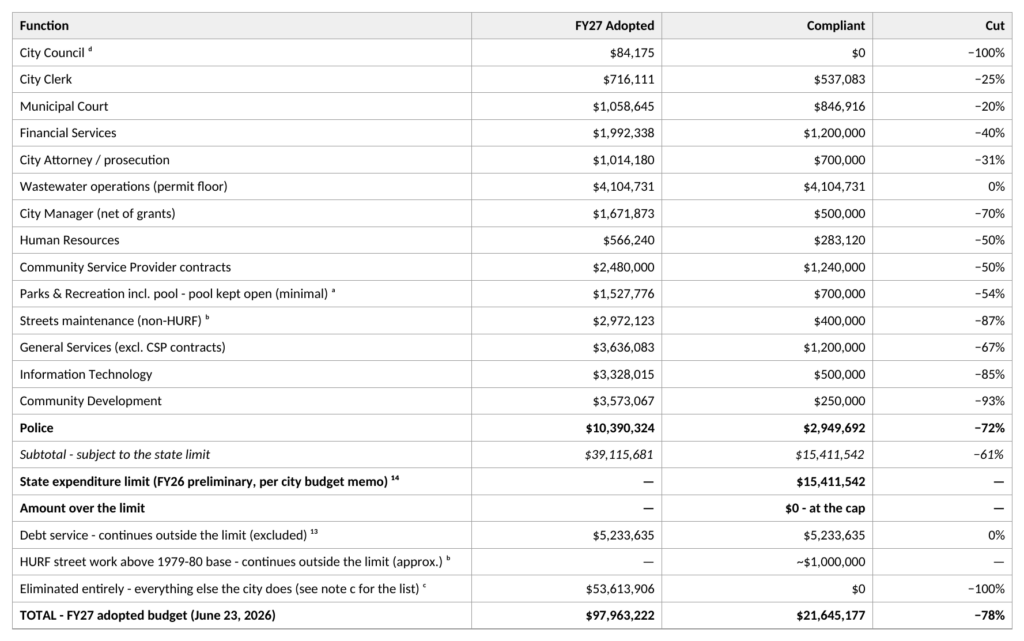
Chart Notes:

a $350,000 for a minimal-hours pool plus $350,000 for minimal parks maintenance – both illustrative estimates, not city numbers. The pool figure of $578,038 is a guess and comes from the Community Idea proposal. It could not be verified and the rows are combined here to avoid double counting.

b The Streets line shows the full Streets Fund adopted budget, which includes the HURF-funded work. In the compliant budget that work continues outside the limit (~$1.0M, shown separately with no Adopted amount to avoid double counting). Total compliant street maintenance is therefore ~$1.4M, a −53% cut overall.

c The eliminated row covers: all grants ($550K), transit ($3.5M), tourism ($2.0M), sustainability ($922K), Public Works beyond streets (~$7.4M), contingency ($5.2M), and all pay-as-you-go capital ($34.0M, including the ADEQ-required injection wells). Small reconciling amounts within these categories are approximate; the row is derived so the Adopted column sums exactly to the full adopted budget.

d Council stipends and expenses zeroed for illustration. This is largely symbolic (0.5% of the cap) and the council itself cannot actually be abolished – an incorporated city must have a governing body (A.R.S. Title 9) – so some minimal cost would persist in practice.

The technical notes above are the fine print. The chart is the story: this is what compliance costs.

Footnotes

  1. The 2022 voter approval of Home Rule covers four fiscal years, through FY2026-27. If Home Rule is not renewed at the July 2026 election, the state-imposed limit would first apply to the FY2027-28 budget, with that year’s figure set by the Economic Estimates Commission. A one-time override or permanent base adjustment would also require voter approval at a subsequent election.
  2. An incorporated Arizona city must have a governing body (A.R.S. Title 9).
  3. City clerk is a required statutory officer; the office also carries mandatory duties for elections (A.R.S. Title 16) and public records (A.R.S. Title 39).
  4. Every incorporated city or town must maintain a municipal court (A.R.S. § 22-402).
  5. State law requires an annual independent audit (A.R.S. § 9-481), adoption of a budget under Title 42, Chapter 17, and uniform expenditure reporting to the Auditor General (A.R.S. § 41-1279.07).
  6. Prosecution of city code violations and misdemeanors is a mandatory function; the in-house office itself could in theory be contracted out, but the duty cannot be eliminated.
  7. Payment of debt service is a contractual and constitutional obligation; default is not a lawful option.
  8. Once a city operates a wastewater system, continued operation in compliance with ADEQ permits is legally required. Amount shown is operations only and excludes the $9.2M in permit-driven capital work (injection wells) budgeted for FY27.
  9. No state statute requires a city to maintain its own police department (law enforcement otherwise defaults to the county sheriff), but continuous law enforcement must be provided in some form.
  10. Highway User Revenue Fund (HURF) money is legally restricted to street purposes; ongoing street maintenance is a practical and liability-driven obligation rather than a statutory mandate.
  11. State law requires the city to adopt and administer a general plan (A.R.S. § 9-461.05); administering the adopted Land Development Code is obligatory, though service levels are discretionary.
  12. The Community Service Provider contracts are budgeted within the General Services department. To avoid double counting, the General Services line shown here excludes the $2,480,000 in contracts, which appear separately under Community programs.
  13. The Arizona Constitution (Art. IX, § 20) excludes certain expenditures from the limitation, principally debt service on bonded indebtedness and other lawful long-term obligations, expenditures of federal funds, HURF spending above the city’s 1979-80 level, and private grants and donations. Local sales tax, bed tax, state-shared revenues, and wastewater user fees are NOT excluded. The debt service exclusion shown assumes all city debt qualifies; the HURF exclusion is approximate. The city’s Annual Expenditure Limitation Report (AELR) filed with the Auditor General is the authoritative source for exact exclusion treatment.
  14. State-imposed expenditure limitation calculated under Article IX, § 20 of the Arizona Constitution, as stated in the city’s FY26 budget memo (preliminary figure: $15,411,542). The FY27/FY28 figure from the Economic Estimates Commission will differ modestly with population and inflation adjustments. Under Home Rule, the limit instead equals the adopted budget.
  15. Skinnier Chicken amounts are the FY27 adopted figures cut in half, rounded to whole dollars (with rounding set so each subtotal equals half the adopted subtotal); Community programs are kept at full adopted amounts. The exclusions are likewise halved.

Source: City of Sedona FY2026-27 Adopted Budget, Official Budget Forms (adopted June 23, 2026); Community Service Provider contracts per April 22-23, 2026 Council budget work session.
Letter to the Editor: Is the State-Imposed Spending Limit Workable in Sedona?

Pete Furman · July 5, 2026 ·

Letter to the Editor: Is the State-Imposed Spending Limit Workable in Sedona?

By Sedona City Council Member Pete Furman

Sedona, AZ — I have been on the Sedona City Council since 2022, and I know that budgeting is a very complex process in Sedona. I believe a well-structured city budget is essential to keep city services running at optimal levels while continuing to help fund the library, the recycling center, and many other community-serving nonprofits. Setting the budget involves every city department, staff, the city manager, the finance director, the council, the mayor, a citizens’ budget committee, and several public hearings. It takes many months to complete. And many say it’s a mind-numbing experience.

The process we follow is enabled by Home Rule. Full disclosure: I am a proponent of Home Rule, but this is not pro v con piece, it’s just an analysis of what might be. As always, I’m speaking only for myself, not for the Council or city staff.

In my view, Home Rule is a mechanism whereby the voters grant the city the privilege of setting an upper bound on spending through its annual budget process. One aspect that I believe makes Home Rule the best tool is that it requires voter renewal on a four-year cycle. This requires the city to justify its past performance and demonstrate an ongoing commitment to good fiscal stewardship, with the voters serving as judges.

Opponents of Home Rule, often unhappy with various spending or policy decisions spanning years, launch efforts to end it. I understand they want a reset – to apply pressure to projects and policies and to enforce a level of fiscal discipline they think is lost.

When these arguments occur, some voices insist that voting Home Rule down doesn’t have to affect the city’s nonprofits or the things residents love, like our parks and the community pool – that we can live within the state-set spending limit. They insist the city uses scare tactics to encourage voters to renew Home Rule.

While it’s true that Council could choose differently, there are laws and mandates from the state that require a city to provide certain things. If money is left over after the mandates, community amenities and nonprofits can be funded. But if Home Rule is voted down and the city is forced under what’s called the state-imposed expenditure limit, there is very little money to work with.

I wanted to put those claims to a test: is it possible to create a budget that funds the nonprofits and keeps the city running at satisfactory levels if Home Rule were defeated? I called it the Skinny Chicken budget. So I spent my Fourth of July weekend, armed with Sedona’s FY2026-27 adopted budget and an AI assistant (Claude), to see what I could do.

Spoiler: it took three tries – and the version that technically complies has bad news – we had to cut the police department by 72%.

To be clear: I don’t support any of these budgets. This was a personal exercise to test what’s actually possible – I’m speaking only for myself, not the Council or city staff. It’s also a ‘wounded duck’, because its likely we’ll all start talking about a one-time budget override and/or a PBA if Home Rule fails.

The full analysis, with every number sourced from city documents, is on my website: https://sedonapete.com/2026/07/05/1759/

Pete Furman Has A Few Concerns About Our Home Rule Debate.

Pete Furman · July 1, 2026 ·

Pete Furman Has A Few Concerns About Our Home Rule Debate. Here We Go Again

Sedona, AZ — Sedona voters are facing another “Home Rule” campaign, and if the “No” arguments feel familiar, that’s because they are. Same arguments, largely the same voices, every four years, for over a decade. The villain changes each cycle – roundabouts, housing, roads, a particular councilmember – but not the rhetoric. It’s like shouting “fire” on a four-year cycle.

It’s strange and frustrating because each time since 1996 the majority has approved Home Rule. They understand the difference between “I’m unhappy with a specific decision” and “let’s kill the mechanism that pays for police, roads, parks, and non-profits to the standards Sedona expects.”

If You’re Upset About Spending, There’s A Process For That

The anti-Home Rule activists resurface in a predictable cycle, not offering input into next year’s budget, but running a campaign to blow up the funding structure entirely. If the goal is to choose good projects and improve fiscal management, that energy would be better spent in the budget process than in an anti-Home Rule ballot measure campaign.

What’s Actually At Stake

Home Rule doesn’t raise taxes and never has. It simply sets a city budget ceiling, based on the revenue the city already collects – responsive to local conditions and local needs.

This year, however, voters are being enticed with a risky alternative: kill Home Rule and live with annual budget override votes in special elections, until a Permanent Base Adjustment (PBA) is approved.

What could go wrong? Special elections have always existed but are rarely used, for good reasons. Preparing for and winning a special election comes with no guarantees. It’s costly, and if a vote fails, it leaves the city with service cuts for up to two years, until a PBA is approved and/or Home Rule restored. Override votes can fail.

Special elections might sound appealing, but they can favor special interests. With turnout typically smaller than in a regular election, a committed, organized group can swing the outcome and push through unrepresentative results.

How many of us are eager to vote annually on a complex and hard-to-understand budget? Even Councilors must catch their breath after the exhausting budget process (speaking from experience). With a low turnout, will a majority truly rule, or the most organized minority?

I can’t see a single reason to advocate for the death of Home Rule.

What’s my advice? (Yes, I’ve been asked by Sedona voters.) Vote YES on Home Rule. Then we embark on the PBA conversation – as soon after this election as we can bear. But please know the conversation won’t be simple. Many won’t have the time or the energy to fully engage. That’s understandable. And in the end, Home Rule might still be the best approach.

Vote YES On Home Rule

Submitted to Sedona.biz on 7/1/26 by Pete Furman. Pete Furman and his wife Lisa live in West Sedona. Pete has served on the Sedona City Council since 2022 and is not seeking reelection. When not riding either his road or mountain bike, Pete keeps local area doctors gainfully employed. The opinions expressed here are his alone and do not represent the position of City Council or city staff.  

Council OKs $97,963,222 FY27 budget

Pete Furman · June 28, 2026 ·

Council OKs $97,963,222 FY27 budget – Sedona Red Rock News

Council OKs $97,963,222 FY27 budget

The vote was 6-0 with Councilwoman Charlotte Hosseini absent. There were no major changes from the tentative budget council approved on May 26.

“We are continuing to hold sales and bed tax revenues flat,” Deputy City Manager Barbara Whitehorn said. “We are seeing year-over-year increases, however, given the global uncertainty, that seems to be a more prudent way to move forward.”

The approval caps six months of work that began with the priority retreat Dec. 16 through 18, during which the council expressed little desire to increase the number of municipal employees and favored a more conservative budget in light of economic volatility. This led the council to call for a zero-based budget model, in which every expense was justified from scratch rather than every department adjusting its previous year’s budget.

The FY 2027 budget marks the second consecutive year the total budget has fallen from its all-time high of $106.1 million in Fiscal Year 2025. While the FY 2027 budget is a 5% reduction from the current year’s $103.3 million budget, that decrease is driven by a 20% drop in capital projects, from $42 million to $34 million, as projects such as the Uptown Parking Garage near completion. The garage does not currently have an opening date because its decorative exterior wall is under structural engineering review.

Operating budget year-over-year grew 4% from $61.235 million to nearly $64 million, with nearly five full-time equivalent employees added, with three of those positions created specifically to aid local schools following a March 25 joint session with Sedona-Oak Creek School District, when council directed city staff to find ways to financially back local schools, which are independent from city government.

This lead to the creation of full-time recreation programming coordinator in the Parks & Recreation Department for after-school programming, a Parks & Recreation janitor to aid the program, and a full-time maintenance worker who will also maintain the Sedona Red Rock High School’s baseball field, with the goal of improving SOCSD student recruitment and retention.

The city committed $76,000 to hire a school security consultant for both SOCSD campuses, and a series of smaller one-time appropriations for SOCSD that focus largely on security improvements — with the independent Sedona Charter School receiving $23,000 in new playground equipment.

Other staff changes in the budget are the creation of a full-time Information Technology support employee, a converting a part-time court specialist to full-time, and converting a part-time bicycle pedestrian coordinator into a full-time position.

In FY 2023, the city had 177.5 full-time employees; 201.65 in the current fiscal year, with a total increase of 4.97 FTEs in the approved FY 2027 budget.

Among the operating increases, the city’s most significant are an Arizona State Retirement System contribution of roughly $1.9 million; a $766,000 increase to the city’s community service contracts with Community Library Sedona; $300,000 for advertising and tourism; $250,000 for a mini street sweeper for the Uptown garage; $150,000 added to the pavement preservation and road rehabilitation contract; $125,000 for an Uptown Community Focus Area design services; $100,000 for pre-approved house plans required under Senate Bill 1529, and $75,000 for updating the city website.

The city also moved to pay off the remaining balance on several debts, including financing for energy conservation equipment; micro-transit vehicles; a vactor truck, a dump truck and snowplow and police vehicles, with at a total cost of $948,053 and an interest savings of $75,548.

Capital Projects

Whitehorn flagged capital projects that several residents had raised as costing more than the budget allocates, such as a debunked claim the city intended to overspend on purchasing the Brewer Road building, home to the Parks and Recreation Department and City Court offices, from SOCSD before any serious talks had occurred.

Sedona City Council candidates Jean-Christophe Buillet and Rich Gay, as part of their campaign, made a social media video citing the city’s West Sedona Intercept Lot at SR 89A and Upper Red Rock Loop. The project, PT-05, carries a $100,000 appropriation in Fiscal Year 2027 to 2028, and last year’s FY ’25 to ‘26 Annual Budget had included a $24.8 million placeholder “for a possible parking garage” that has since been removed.

“The eventual plan was to possibly add a parking garage out there, but it was determined in evaluating the capital projects that that was an unlikely thing for us to do in the next 10 years,” Whitehorn said. “So that is no longer in the budget, there, so if you look at last year’s budget, there was a placeholder for that, and in … coming fiscal year, that is not in there.”

The modeling approach for the Fiscal Year 2027-28, budget will be decided at a future meeting.

Amphitheater seeks partner

Pete Furman · June 1, 2026 ·

Amphitheater seeks partner – Sedona Red Rock News

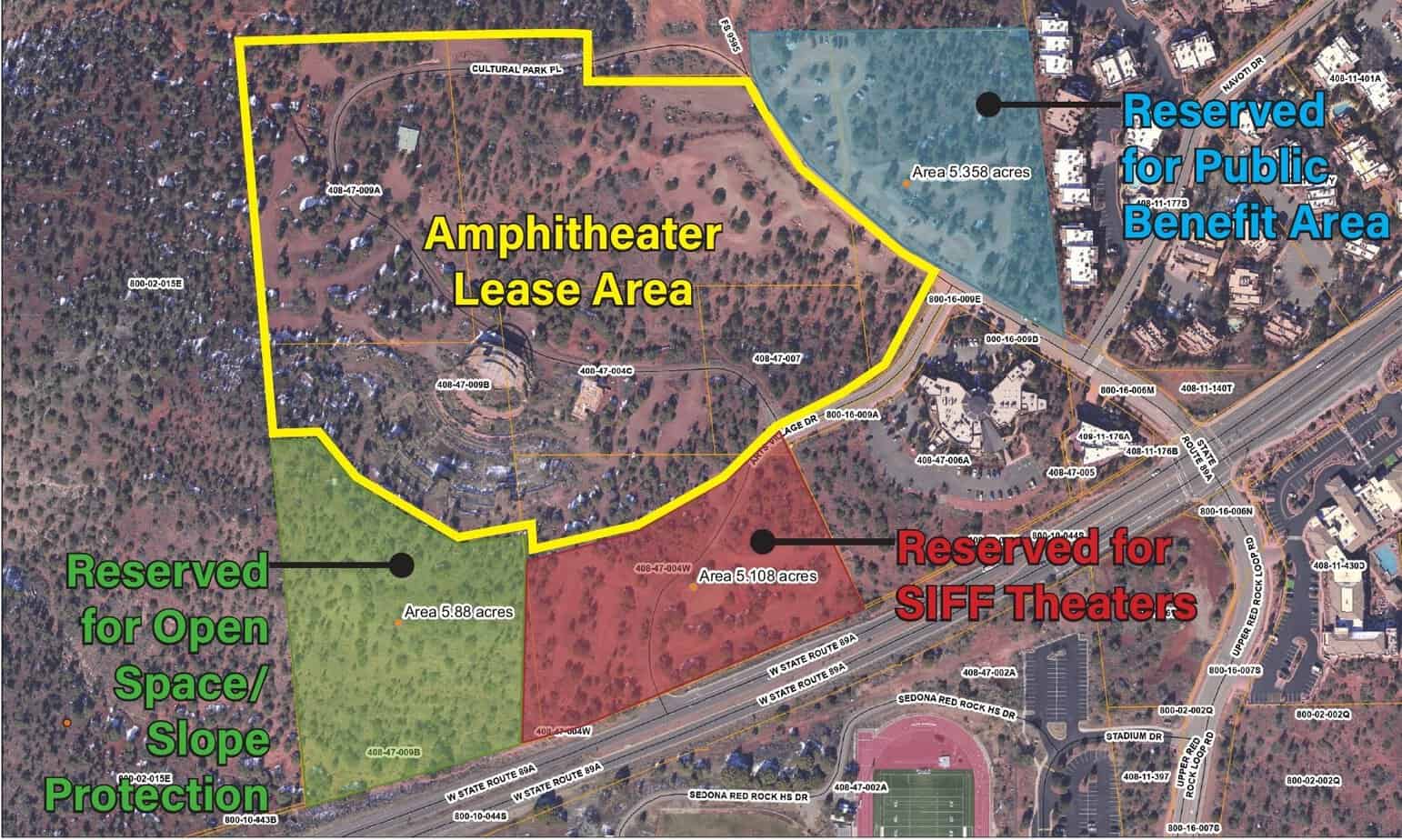
Park parcels could be roughly divided among the amphitheater, a potential Sedona International Film Festival complex, an area for “public benefit” and open space. Photo illustration courtesy city of Sedona.

Council OKs SCP 2.0’s letter asking for plans to revive 5,500-seat outdoor venue

The Sedona amphitheater is seeking a partner for a serious long-term commitment, music is a must.

The Sedona City Council unanimously approved a non-binding letter of intent with Sedona Cultural Park 2.0 nonprofit — and issued a request for information open to any interested organization — during its Tuesday, May 26, meeting. Councilman Derek Pfaff was absent.

The public request allows other potential groups to develop business plans exploring options to bring live music back to the 5,500-seat Georgia Frontiere Performing Arts Pavilion that has been shuttered since 2003.

“SCP 2.0 is not requesting construction funding, operational funding, subsidies or taxpayer dollars from the city of Sedona,” SCP 2.0 board member Jennifer May said during public comment. “Our intention is to explore whether a revitalized amphitheater could be supported through private philanthropy, sponsorships, strategic partnerships and professional venue operators.”

Both of the documents are open to any individual or group. The letter of intent is a template City Manager Anette Spickard can sign with any qualified party, and signing it is not required to respond to the Request for Information, City Attorney Kurt Christianson said.

Under the letter, which runs through the end of 2026, SCP 2.0 will research whether renovating and operating the amphitheater is financially viable and how it could be structured on up to 25 acres of the 41-acre Cultural Park that the city purchased in November 2022 for $20 million.

The remaining acreage on the 41-acre site breaks down as follows:

■ 5.88 acres of slope protection and open space in the southwest corner.

■ 5.358 acres designated as a “Public Benefit Area” in the northeast corner.

■ Roughly five acres along State Route 89A, west of Yavapai College’s Sedona Center campus, where the Sedona International Film Festival could potentially construct a new theatre complex, a use the council gave initial direction to in December, pending completion of a land survey and appraisal.

“We’re kind of in the RFI phase with SIFF, so there’s nothing set in stone yet,” Christianson said. “No promises have been made on either side.

“They have proposed some plans with Community Development, but it hasn’t made it outside of” that department yet for review.

Council gave direction to Community Development Director Tony Allender to investigate three community uses that ranked above the amphitheater from an April resident survey: A festival space, a smaller gathering space and a recreation center.

Council members indicated a potential recreation center in particular would not necessarily be located at the Western Gateway.

“When I think about a unique, attractive, daily use thing like a rec center, you don’t put it at the edge of your town, you try to put it more in central parts of your town,” Councilman Pete Furman said. “I can think of a couple in West Sedona that could be a better location for it, and so that’s got to be part of the conversation going forward.”

The RFI expires on Wednesday, Sept. 30. Staff would likely spend October preparing information, aim to present it to the council in November, and could return around January for a possible second discussion on whether to issue a Request for Proposal, according to Christianson.

Request for Information for Cultural Park Amphitheater:

The city of Sedona issued a Request for Information on Monday, June 1, inviting private entities to share their interest and ideas for the restoration and operations of the Sedona Cultural Park Amphitheater, a 5,500-seat outdoor performance venue located on city-owned land in West Sedona called the Western Gateway.

The outdoor amphitheater was in operation primarily as a music venue from 2001-2003 and hosted nationally recognized artists. The city purchased the property in 2022 and is now exploring options to bring the venue back as a cultural and economic asset for residents and visitors.

The city is seeking responses from private organizations and businesses with expertise in developing, operating and managing outdoor amphitheaters, performing arts venues or comparable entertainment facilities. The RFI is an information-gathering step that may lead to a formal Request for Proposals process for a ground lease of up to approximately 25 acres of the city property. The city intends to lease the property at fair market value, with renovation and operating costs the responsibility of the private party.

Respondents are encouraged to share creative ideas for programming, business models, community benefit components and approaches to comply with Sedona’s sound attenuation requirements. The city is particularly interested in how a restored venue could serve residents and complement Sedona’s arts and tourism economy.

Organizations interested in scheduling a site visit may contact the city to arrange access during regular business hours with 48 hours advance notice.

The RFI package contains additional information, including a structural condition assessment, a site diagram, site photographs, zoning documents and a non-exclusive Letter of Intent available to respondents upon request. To learn more and to respond to the RFI, visit https://sedonaaz.bonfirehub.com/opportunities/238073.

Applications are due by Wednesday, Sept. 30.

  • « Go to Previous Page
  • Go to page 1
  • Go to page 2
  • Go to page 3
  • Go to page 4
  • Interim pages omitted …
  • Go to page 22
  • Go to Next Page »

FISCAL RESPONSIBILITY • HONESTY • OPEN GOVERNMENT

  • Email
  • Facebook
  • Instagram
  • LinkedIn
  • YouTube

Sedona City Councilmember Pete Furman

Copyright © 2026 | Paid for by Pete Furman | Website by Pivot Strategies, Inc.

  • Home
  • About Pete
  • In the News
  • City Meetings
  • Contact Pete