• Skip to primary navigation
  • Skip to main content

Sedona City Councilmember Pete Furman

  • Home
  • About Pete
    • Meet Pete
    • Pete’s Priorities
    • Pete’s Perspectives
  • In the News
  • City Meetings
    • Upcoming Sedona City Meetings
    • Sedona City Meeting Summaries
  • Contact Pete
  • Show Search
Hide Search

In the News

Council talks tax trends and STR revenue share

Pete Furman · September 4, 2023 ·

Council talks tax trends and STR revenue share – Sedona Red Rock News

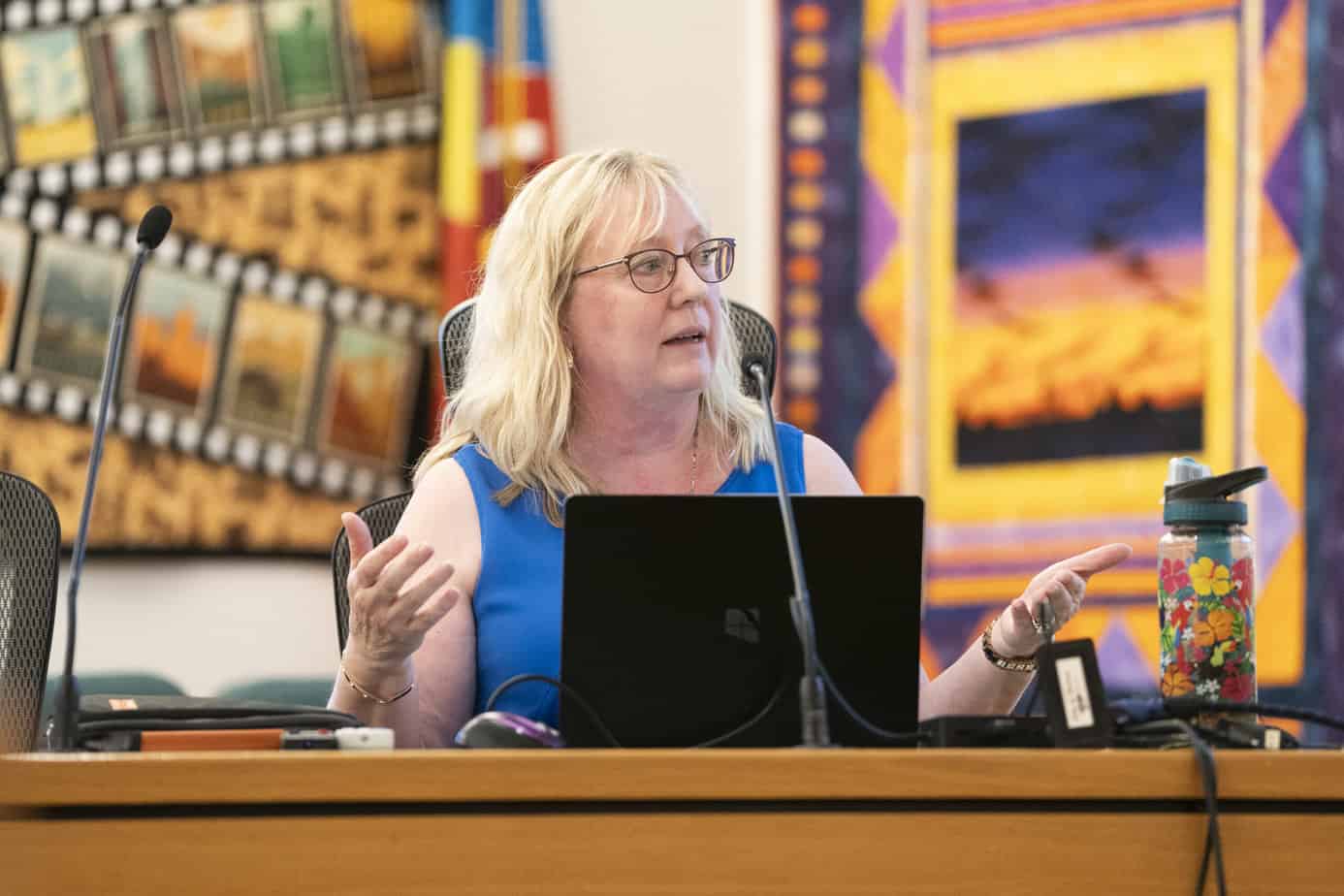
Sedona Director of Finance Cherie White gives a presentation on the city’s sales and bed tax collections for fiscal year 2023 during the Sedona City Council meeting on Tuesday, Aug. 22. Photo by David Jolkovski/Larson Newspapers.

Sedona city staff presented the preliminary sales and bed tax results for Fiscal Year 2023 to the Sedona City Council on Tuesday, Aug. 22, which showed that collections were $1,348,274 below Fiscal Year 22 collections and $6,458,502 below the FY 23 budget estimate.

The council also pressed finance director Cherie White on providing the proportion of bed tax paid by short-term rentals. White responded with concerns about taxpayer confidentiality.

“I keep trying to look at this data to understand the impact of short-term rentals on our community,” Councilman Pete Furman said, examining a graph showing historical changes in revenues. “Why can’t we get this split up between short-term rentals and hotels?”

“Because of the confidentiality rules,” White said. She had earlier explained that Arizona Department of Revenue rules prohibit disclosure of any information about a segment of taxpayers when there are fewer than 10 payers in that category on penalty of being denied access to the detailed taxpayer data in future.

“Forgive me for pushing this a little bit more, but why does Scottsdale disclose that number?” Furman asked.

“I can’t answer for Scottsdale,” White said.

“Did you ever try to get an opinion from ADOR as to whether you could actually do this and not violate the rules?” Furman continued.

“It’s not always easy to get to people at ADOR who will be helpful,” White said. “Who I talked to were the sales tax experts from the League [of Arizona Cities and Towns].”

“Given the significance of this issue to our community, I would like to see us push a little bit more,” Furman said. “The customer here is the person staying in the room, and there’s thousands of those people, so we’re not actually exposing the data for the individual … Look at the city of Scottsdale’s very public website and very beautiful charts,” Furman said, holding up an example for the audience.

“If there’s over a thousand short-term rental properties in the city, then if we’re getting an aggregate value of bed tax from them, how does that violate confidentiality?” Councilman Brian Fultz asked. “It’s more than 10 and we’re not looking to understand them at an STR level.”

“It’s not just 10 in the category, it’s if 10 or fewer make up the majority of what’s happening in that category,” White said.

“That would imply that there are fewer than 10 owners of the 1,000 — or that 10 owners of the more than 1,000 STRs somehow have high concentration and therefore they would be exposed by us knowing what the aggregate amount of bed tax is?” Fultz pursued.

“I cannot answer that question in a way that would satisfy you without violating confidentiality rules,” White said.

“I’m going to chime in with Councilor Furman that some way, somehow, we need to push ADOR on this,” Fultz said.

“It’s not based on the owners, it’s on who’s paying the taxes,” City Attorney Kurt Christianson said. “If there’s less than 10 major players who are paying the taxes.”

“That’s goofy,” Fultz said.

City manager Karen Osburn suggested that the city could possibly report a number for traditional lodging, as there are “many more than 10” establishments in that category.

“I’ve had those conversations with the League,” White said. “If I give you that information, you can just take that number minus the other number that you see there and you have the difference.”

“But we don’t know the who behind that subtraction calculation, so how is there a violation there?” Fultz said.

“The rule is if it’s 10 or fewer that make up the majority, we cannot disclose that,” White repeated.

“This is important for our community,” Councilwoman Kathy Kinsella said. “I want that number as well.”

Mayor Scott Jablow and Vice Mayor Holli Ploog directed Christianson to reach out to Scottsdale to find out, in Ploog’s words, “how they’re getting around this.”

“I’ve reached out to them,” White said. “They didn’t respond.” She repeated that she had talked to a League official instead.

“Did he tell you why they’re doing it, how they’re doing it?” Councilwoman Jessica Williamson inquired. “I don’t think this is the right forum to share what he said,” White said.

“Kurt, we’ll proceed,” Williamson said.

Sales Taxes

FY 23 sales tax collections were $31,755,509, down 3% from FY 22 and 13% below the budget, and bed tax collections were $8,587,989, down 4% from FY 22 and 16% below the budget. Adjusted for inflation, sales and bed taxes were down 6% and 7% from FY 22, respectively.

“We were actually very conservative,” White said of the city’s high predictions for FY 23 revenues. “We thought we were doing very modest increases.” She attributed the city’s official optimism in part to the advice of former Sedona Chamber of Commerce President Candace Carr Strauss, who left the post in March 2022, and the resulting underperformance to tourists choosing to visit Europe instead of Sedona, the effects of inflation, the talk of a possible recession and the city’s hold on destination marketing.

From 2019 to 2023, sales tax collections increased by 49% and bed tax collections by 79% in unadjusted dollars. Cumulative inflation for the four-year period, as derived from the Consumer Price Index, was 20%. The hotel sector saw the largest increases, with hotel sales tax collections rising an unadjusted 82%, followed by retail at 52%. Restaurants and bars paid an extra 38%, while communications and amusement collections rose only 13%, less than the inflation rate.

Estimated taxable sales for the fiscal year came to $907 million. Retail accounted for $309 million of the total, hotels for $252 million and restaurants for $172 million. Average annual hotel occupancy declined from 68% in FY 22 to 65% in FY 23.

Both leasing and retail collections declined in May and June 2023 compared to 2022, while hotel and restaurant collections were down in May compared to the previous year but ticked upward in June by 7% and 13% respectively. Sales and bed taxes were lower from August through October of FY 23 than they were in those same months in FY 22, but were higher in March and April than they were the previous year.

Council defers Jablow’s OHV ban pending negotiations

Pete Furman · September 4, 2023 ·

Council defers Jablow’s OHV ban pending negotiations – Sedona Red Rock News

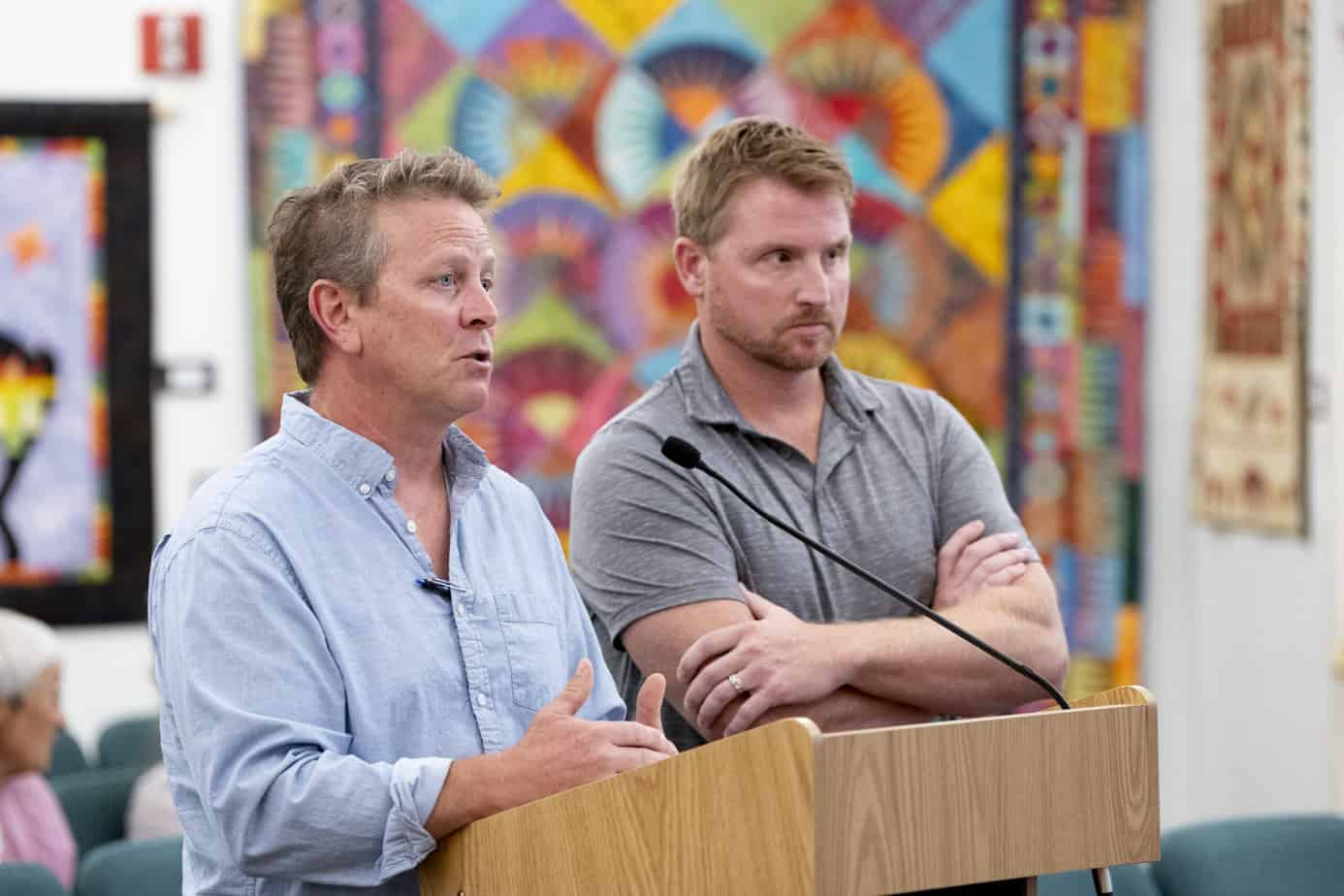
Dan Candler, of Outback ATV, and Jimmy Custer, of Red Rock ATV, answer City Council questions about a possible agreement between the city and a number of OHV rental companies during the Sedona City Council meeting on Tuesday, Aug. 22. Photo by David Jolkovski/Larson Newspapers.

The Sedona City Council agreed to defer consideration of Mayor Scott Jablow’s proposed OHV ban pending the city’s completion of a voluntary agreement on noise and traffic reduction with four of Sedona’s OHV rental companies during its meeting on Tuesday, Aug. 22.

As summarized by city attorney Kurt Christianson, the four rental companies wrote in a letter that they will commit to installing turn signals on their vehicles, providing customer education on driving on paved roads, governing their vehicles to restrict them to a maximum speed of 35 mph, installing quieter mufflers on their vehicles as available, discouraging the use of Morgan Drive, installing color-coded flags on their vehicles and supporting the city’s efforts to petition the U.S. Forest Service for a permitting system and daily limits for OHV trailheads.

“In a paragraph in the agreement, there’s talk about vehicles monitored by GPS,” Councilman Pete Furman said. “What’s the status of the discussions in the agreement here with our rental companies about whether they are willing to step up and do private enforcement of their private agreements with customers for speed limits?”

“We’ve actually taken the next-step approach that if there’s a rapid braking or there’s a rapid acceleration, it actually sends us a company email instantly,” said Dan Candler of Outback ATV. “For instance, somebody’s at the front desk, they would see this vehicle is now acting erratically. That way, they would take a closer look and they can replay the whole route in real-time of the vehicle … We can reach out to the customer right then and there and find out if something’s wrong with the car, they’re behaving badly, then we can take care of it right away.”

“We do have currently certain penalties for certain things, and one of them is for certain locations that we don’t allow vehicles to go to, and if they go there, then it’s clearly stated in the contract that you will be penalized financially for that,” Candler added. He said that such penalties were rare due to their customer education process.

Sedona Mayor Scott Jablow speaks on his proposed OHV ban at the meeting on Tuesday, Aug. 22. David Jolkovski/Larson Newspapers

Permit System

Jablow discussed trying to get the U.S. Forest Service to impose an OHV permitting system to limit access to public trails within the Coconino National Forest. Most OHV trails are outside the city limits.

“The permitting system is key,” Jablow said. “What I really want is that permit system, and they’ve agreed to support that permit system,” referring to the OHV companies.

“Our ultimate goal is to get a permitting system,” Vice Mayor Holli Ploog agreed. “More than two years ago we had a meeting with the Forest Service here and we said we need a permit system.”

“There’s an oversaturation of this use in the forest area, there’s an oversaturation of this use on the city streets of Sedona. A permitting system is the only thing … that is going to limit that,” Councilwoman Kathy Kinsella said. “The industry support for a permitting system, which I’m grateful for, is a big give.”

She described it as “the only hope” of getting the Forest Service to concede to the city’s demand.

“A linchpin to making real progress for the long haul is getting the U.S. Forest Service to act, which they have been woefully slow and unwilling to do so,” Councilman Brian Fultz said.

“If we can reduce the number overall, we would have less in the forest, less in our neighborhood, less on 89A.” Jablow said.

“Get comfortable. You’re going to be waiting,” Councilwoman Melissa Dunn said regarding the permit proposal.

“If the Forest Service decides no permits, then we go the legal route, and we’ll get sued,” Jablow said. “We can always bring back the ordinance,” he added, before remarking, “I’m not using that as a hammer.”

“I do not believe that implementation of an areawide limited entry permit system for OHVs is feasible, nor do I believe that it would be the correct management action at this time,” Coconino National Forest Supervisor Laura Jo West wrote to the council on Jan. 27, 2022. “Motorized use is a legitimate use of national forest lands.”

No USFS representatives attended the meeting. The Greater Sedona Recreation Collaborative, an ad hoc working group of government officials and business owners discussing OHV use, also had no formal representation at the meeting.

Road Closures

“I’m concerned about Morgan Road,” Jablow said, noting that the process to implement a permitting system was likely to be lengthy. “I was wondering if we could discuss, and see how the council feels, about this ordinance going into effect — the banning of OHVs on Morgan Road only until such time as there’s a permitting system in place … That would help remedy some of the issues that the people on Morgan Road are going through.”

“It’s within council’s authority to designate OHV routes and to close routes to OHVs,” Christianson said.

“Why Morgan Road?” Dunn asked. “I hear lots of residents complain about Schnebly [Hill Road]. Why would we choose just the one? Are we in essence opening ourselves to more annoyance from residents who say, ‘What about my road?’ Should we be considering, if we were to close this, to close it to multiple roads where we know that residents today have issues with the volume of traffic?”

“It’s a fair question,” Christianson said. “If you’re going to close one, why not the others?”

“In a perfect world, I’d ban ATVs, but I’d also ban motorcycles and people who don’t use their turn tickers. We don’t live in a perfect world,” Councilwoman Jessica Williamson said. “Under the voluntary agreement [residents are] going to get quieter vehicles … I don’t see any benefit to the city or the residents to be caught up in litigation while nothing gets better without any guarantee or any reason to think at the end of it the city would prevail anyway … We can fashion a compromise that gives residents who object to OHVs some relief.”

“I look forward to a time when if someone goes over 50 miles an hour on a trail, the computer shouts ‘slow down,’” Williamson added.

Sedona City Attorney Kurt Christianson answers questions.
David Jolkovski/Larson Newspapers

Debate over ‘Safety’

“The ordinance, as I understood it, was about improper equipment for safety within the jurisdiction of Sedona,” Dunn said. “When I look at the volunteer list [in the letter from OHV owners], I see very few items that have anything to do with safety. There’s nothing in our ordinance that has anything to do with noise.”

“A lot of these do have to do with safety,” Christianson said, then referenced the agreement’s speed limits, education for renters and GPS installation requirements as examples.

“Do we have a big problem that you’re aware of in Sedona with OHVs going beyond 35 mph now?” Dunn asked.

“Not generally, ” Christianson said.

“I wasn’t quite sure how the GPS was actually a safety thing,” Dunn continued.

“That safety is primarily for outside the city, so they can’t do doughnuts,” Christianson said.

Dunn then described the proposed agreement’s provisions as “soft language” and “squishiness” and repeatedly said that “we have no control” over a number of aspects of the OHV industry.

“It doesn’t apply to anyone who owns their own [OHV], it doesn’t apply to anyone who brings in their own from outside of the state or outside of our city,” Dunn said. “It doesn’t apply to any new businesses that open, because they have not signed this commitment, nor does it apply to anyone who buys a business within the city limits … There is a lot of faith that we as a city are having to put in the hands of a few businesses.”

“If this meets our demands, then this ordinance should be tabled, because it doesn’t follow what’s inside of the voluntary commitment,” Dunn summarized. “At this point, what I am is a little confused as to what we as a council were and are and want to actually do for the residents.”

Commend Sedona City Council for its ordinance on new ordinances

Pete Furman · July 31, 2023 ·

Sedona City Councilman Pete Furman

We would like to commend Sedona City Councilman Pete Furman and Councilwoman Kathy Kinsella for getting their ordinance on ordinances passed de facto unanimously at the July 11 meeting and thereby requiring new city laws to be read twice.

Unfortunately Furman, who had spearheaded the new policy, was excused from the meeting and was thus unable to vote on it, but it passed 6-0 and he most certainly would have been the seventh vote.

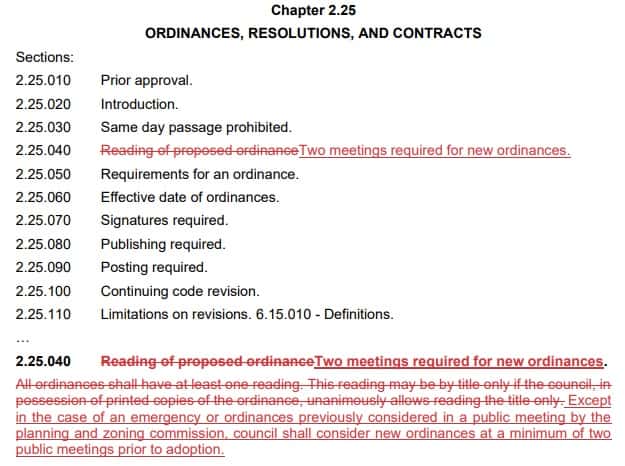
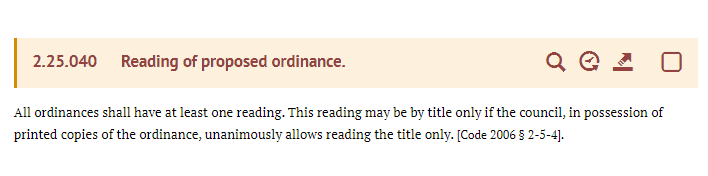
The change was relatively simple. Sedona City Code Section 2.25.040 currently reads, “All ordinances shall have at least one reading. This reading may be by title only if the council, in possession of printed copies of the ordinance, unanimously allows reading the title only.”

The new amendment changes that language to require “two readings.”

Sedona City Councilwoman Kathy Kinsella

While seemingly inconsequential, in practice it will give residents at least one more meeting — and roughly two weeks of time depending on when council officially reads the ordinance aloud — to hear what the new law affecting the community will involve. This means that items that appear at one council meeting can’t be immediately made into city law by the end of that meeting.

That potential swiftness has always imperiled the public, who could be blindsided by a new ordinance conceived, crafted, debated and made into law during a single heated meeting. Residents have then had to spend time and effort organizing a referendum or convincing officials to repeal or modify an ordinance rather than letting cooler heads prevail and waiting for one more meeting so the public could weigh in. To prevent bad ideas from becoming bad laws, this pause lets residents contact council members directly or through the medium of Letters to the Editor in this publication, or motivate their neighbors to show up and speak against disastrous proposed laws.

It’s a win-win for both good laws and bad, as proponents of new and popular ordinances could have one more meeting to show up and voice their support.

The ordinance also states that a reading of a proposed ordinance by the Sedona Planning and Zoning Commission could count as one hearing under the new law. New ordinances could also become law in an “emergency,” but aside from the declared emergency during the COVID-19 pandemic or some pending state-imposed deadline or court order, there is almost no “emergency” that can be invoked to deny the public two readings.

The caveat is that previously, city council members could skip reading the whole ordinance aloud to the public and instead just read the title if council unanimously decides that’s enough for them.

Reading ordinances in their entirety is not for council’s benefit. It is for us, the public, the residents of Sedona. Council members have time to meet with the city attorney or city manager or department heads for hours to discuss new laws and their implications. We, the public, do not have this luxury, so ordinances should be read in their entirety for the public.

One argument against reading whole ordinances aloud is the length of the meetings, which is bit silly. A regular Sedona City Council meeting routinely lasts four or more hours, while a contentious one with controversial items can last six or more hours.

Compare that to the brisk one-hour meetings in Camp Verde, which has 2.32 times more land and 25.4% more residents. Cottonwood — which has 24.2% more people, a comparably-sized budget and far more city departments and city services Sedona lacks like a municipal fire department, a recreation center and a city-run library — has meetings that barely break an hour. Even this spring, when Cottonwood had its most contentious meetings in years, they still ended in less than three hours.

New ordinance or not, Sedona’s meetings could be shorter if council members were less verbose, or formulated questions before meetings rather than pontificating in stream-of-consciousness ramblings that lack actual questions, or if the mayor or vice mayor running the meetings kept debate limited and council members focused on the task at hand. Or, council could have more than one marathon meeting per fortnight, and instead, more shorter meetings.

Alternatively, council could make the reading of an ordinance a part of the meeting that residents would want to watch rather than just a bullet point on the agenda. Instead of having the city attorney read the ordinance from a table, council should go one step further and make the reading a full-on spectacle.

John Conway, or someone with his equally booming and commanding voice, could read the ordinance aloud dressed in 1770s colonial garb and powdered wig. Tom and Shondra Jepperson could read the ordinance in tandem dressed as T.C. and Sedona Schnebly. Residents or supporters who proposed, advocated for or shepherded an ordinance through the process could be recognized for their public spirit by being chosen to read the ordinance into the record.

Lawmaking is boring, but it doesn’t have to be.

City council increases proposed budget to $85.6 million

Pete Furman · June 29, 2023 ·

Members of the Sedona City Council signal their votes on a decision package during the council’s budget work session on Thursday, June 15. Photo courtesy city of Sedona.

After two days of discussion on June 14 and 15, the Sedona City Council decided to increase the proposed budget for Fiscal Year 2024 from an estimated $84.5 million to an estimated $85,653,790.

New Gated Community

The city’s new director of Public Works, Kurt Harris, revealed that the city is considering closing the public Back o’ Beyond Road to non-resident traffic.

“We’re tracking all of the pedestrians and bicyclists that are going in there to use for that [federal] grant application, and that’s to try to look at a whole concept of how to remove bicyclists and pedestrians from that whole road,” Harris said. He suggested the possibility of building a segregated path or access for non-resident foot and cycle traffic. “There’s also another project we’re trying to do, is put an automatic gate there … make it safe and easier for the residents to get in and out.”

“That’d be great,” Mayor Scott Jablow said.

Councilman Brian Fultz referred to an alternate proposal to eliminate trailhead access to Cathedral Rock from Back o’ Beyond completely as “brilliant.”

“It’s our appetite to push hard on the [U.S.] Forest Service to play ball,” Fultz said.

New deputy city manager Andy Dickey noted that while the city has tried to get the Forest Service to close that trailhead multiple times, “it’s a nonstarter with them.”

Housing & STRs

Vice Mayor Holli Ploog commented that contractors and homebuilders have complained to her that the city’s building codes add prohibitive costs to new home construction projects.

“Those people say that, but they never quantify or identify what specific things they’re talking about,” City Manager Karen Osburn said. “If those people would like to give us the list and the associated cost … produce it, and we’ll respond to it … No one’s been able to produce the list.”

“A lot of these things — they might add to the cost of housing, but they’re adding a very minimal percentage to the cost of a house that’s already a million dollars,” housing manager Shannon Boone said.

When asked by Councilwoman Jessica Williamson how much funding it would be “prudent” to allocate to housing in the coming fiscal year, Boone proposed $12 million for four projects.

“I would be perfectly delighted to be in the position of your needing more money in order to get some housing built,” Williamson told Boone.

“This just feels like all of a sudden we’re going to be the biggest landlord in town. Or we’re going to be the money behind the landlord,” Councilman Brian Fultz said.

“I’m not sure that we as a city yet have done everything that we can to … encourage low square-footage, market-rate multi-family housing in town,” Councilman Pete Furman said.

“The only thing holding us up is the financing,” Jablow said. “Enough has been done for market rate.”

“Even those are very difficult to build,” Boone said. “I’m talking to developers who want to build something like that, and they still need subsidies.”

Osburn said that the Sunset Lofts project “is our fastest opportunity to actually get units built.” The development is currently in limbo while awaiting [U.S. Department of Housing and Urban Development] financing; the city will likely need to contribute another $2 million to the project, bringing the per-unit cost to over $317,000.

Boone estimated the per-unit subsidy for city housing projects currently underway as $80,000 per unit.

The city’s short-term rental specialist Teresah Arthur informed council that compliance with the city’s STR permitting program is at 95%, with 1,092 permitted properties out of 1,105 reported listing. “We seem to have stabilized,” Arthur said, adding that there have been fewer than 10 neighbor complaints so far about STR owners failing to notify adjacent residents about their properties’ status.

“I’m surrounded by them, and I’ve only seen one notification,” Furman said.

On the Road Again

The council was in favor of spending $64,500 to install TVs in the trailhead shuttles, which Transit Administrator Robert Weber said “would be a good way to convey whatever messaging we wanted to convey” to “a captive audience of 300,000 people a year.”

Sedona Cultural Park

City staff are planning to put out an RFP for a consultant to advise on the master planning of the Sedona Cultural Park in September, with the master planning to begin in January 2024.

When Jablow mentioned the ongoing public interest in restoring the event venue as well as possibly constructing housing on the site, Osburn said, “Those two uses are completely incompatible … The community’s going to tell us, but in terms of having both of those things exist, I don’t think that’s an option.”

Osburn did not explain why she declared those uses to be incompatible.

In the meantime, the city has been in discussion about using the park as a car camping site for local workers via the Verde Valley Homeless Coalition, which would cost around $400,000 in management expenses and supplying portable toilets and showers.

“One of the things I really like about this is it would enable us to count this population [of car workers],” Boone said.

Going to the Dogs

Council spent 44 minutes discussing a $55,320 line item to install shade structures and grass at the Sedona Dog Park at Posse Grounds Park before eventually deciding to leave the item in the budget and possibly reconsider it at a later date.

When the city council approved the dog park in January 2004, its construction and operation was supposed to be funded by Sedona Dog Park Inc., a private nonprofit organization.

Ploog and Councilwoman Kinsella argued that as the council had already agreed to test a partial grass surface at the dog park provided water use could be reduced, it was necessary to proceed with the installation.

“I don’t want something that looks like we’re reneging on a promise,” Kinsella said.

“The decrease in the water usage is green-washing. It’s whacking the mole,” Williamson commented.

“The Yappy Hour folks are very set on the grass,” Parks & Recreation Manager Josh Frewin said, adding that conversely, parents dropping their kids off at soccer games were not happy to see dogs urinating on the field where their kids were about to play.

“Parking is a huge issue,” Frewin admitted in response to a question by Councilwoman Melissa Dunn about the available parking for expanded events at Posse Grounds. The city has in recent years eliminated approximately 300 nearby parking spaces by closing Soldier Pass Road to parking.

Departures

The exodus of city staff appears to have intensified over the last six months. Human Resources Manager Brenda Tammarine informed the council that from July 2022 through June 15, 2023, 51 out of 165 city employees left, a turnover rate of 31%. Thirty-four of these positions were full-time and 17 were part-time. The turnover rate for the previous fiscal year was 22%.

However, Tammarine noted, while the city is having trouble finding “highly qualified candidates” for management positions, it recently received 15 applications for a janitor’s position within a 14-hour period.

City finance director Cherie White said that she anticipates another 15 retirements over the next five years. Code Enforcement Officer Brian Armstrong will be retiring shortly, followed by Tammarine herself, most likely in the first week of January 2024.

Osburn will leave the city in the spring of 2024.

“I am eligible to retire next year. I am hoping to do so in the spring-ish timeframe,” Osburn said, adding that recruitment for her replacement will begin “end of August, beginning of September.”

In addition to keeping up with turnover and replacing the city manager, the city will be looking to hire a second deputy city manager as well as two tourism coordinators and a tourism manager.

“I do ponder a question about whether we should pursue an independent analysis of employee satisfaction somehow, if there isn’t something we’re missing,” Furman said.

“I remember a parks and rec director, couple of them, who just said, ‘I can’t deal with this anymore,’ and I don’t think other communities have that,” Williamson said. “The stress of having to deal with as much public scrutiny, anger, lashing out at our staff — it’s going to have an effect on them.”

Osburn said the city was “struggling” with “how to preserve the sanity of our staff.”

Fultz queried the city’s financial commitment to recruiting.

“You’re only going to spend $50,000 on recruitment and relocation in a year? OK. That’s not much,” Fultz said.

City council offers to fund 80% of Visitor Center

Pete Furman · June 25, 2023 ·

City council offers to fund 80% of Visitor Center – Sedona Red Rock News

Sedona Chamber of Commerce President and CEO Michelle Conway speaks to the Sedona City Council on Tuesday, June 13, about having the city fund the Uptown Visitor Center. Photo by David Jolkovski/Larson Newspapers.

The Sedona City Council voted Tuesday, June 13, to offer to fund 80% of the operational costs for the Sedona Chamber of Commerce’s Uptown Visitor Center for the coming fiscal year.

Following the chamber’s April decision not to pursue an extension of its tourism marketing contract with the city, the chamber “determined we are unable to fund the Visitor Center,” chamber President and CEO Michelle Conway told the council. The chamber offered to continue running the Visitor Center under contract to the city for $530,000, or alternatively to rent the building to the city for city staff to operate. If the city did not choose to pursue either of these options, Conway told the council, the Visitor Center would close in August.

City staff recommended against council approval on the grounds that “the Visitor Center may not be delivering services commensurate with the cost of operations” and suggested that if the council did want to provide Visitor Center funding, it should be limited to 80% of the center’s direct costs.

“Why is it important to you that it stay open?” Councilwoman Melissa Dunn asked Conway.

“It’s an institution,” Conway said, comparing the Visitor Center to the Sedona Public Library or the Humane Society of Sedona. She added that the center “evokes civic pride” and “sets the stage for how Sedona is perceived” as well as helping visitors understand “the potential dangers of hiking.”

Councilman Brian Fultz wanted an update on the chamber’s financial health.

“You clearly stated that you were intending to operate the Visitor Center,” Fultz said. “Now you’re saying, ‘well, we don’t think we can do that.’ What is it overall that you are going to be able to do in the fiscal year? … What committed budget do you have?”

“We’re talking today about the Visitor Center,” Conway said, before adding, “Not even the first quarter.”

“I’m trying to understand whether we really need to fund this or whether you could fund this,” Fultz continued.

“We cannot fund the Visitor Center. Period,” Conway said.

“Out of respect to the city and the years of partnership we’ve had together, we wanted to provide the city with the first opportunity to continue the operations of the Visitor Center,” elaborated Jennifer Perry, chairwoman of the chamber’s board of directors.

“I’m not getting my question answered when the day is done and it sounds like you’re unwilling to answer it, so I yield,” Fultz said.

Councilwoman Kathy Kinsella was interested in obtaining the chamber’s list of volunteers and their contact information.

“If funding doesn’t come through and you close the doors Aug. 1, what happens to the volunteer list?” Kinsella asked.

“If you would like it, we could talk about it, but that’s the intellectual property of the Sedona Chamber of Commerce,” Conway replied.

If the city were to rent the building only, Kinsella continued, “would the volunteer list be a part of that?”

“It would be up for discussion,” Perry said, but added that the volunteers would have to agree to the chamber sharing their information publicly with the city.

During the public comment period, former Vice Mayor John Martinez told council that he had asked some of the Visitor Center volunteers if they would be interested in volunteering for the city if it were to take over the Visitor Center, and they had told him they would not.

Vice Mayor Holli Ploog queried the chamber’s inclusion of an administrative overhead fee in its Visitor Center budget and its proposed retention of some Visitor Center revenues.

“If we’re paying 100% of the cost of the Visitor Center, why should you earn revenue from it?” Ploog asked.

“This is a business, and we’ve been passing through services for years,” Perry said. “That’s not good business.”

“I really agree with you. I don’t think that was a smart thing to do. But now we’re renting the whole thing,” Ploog said. “It’s a rub.”

“It’s not business sense to do work just to do work,” Perry said. “If we are to run it, the board feels strongly we should be running it with best practices of business.”

Councilwoman Jessica Williamson described funding the center’s operation as a question of “government’s role in a community.”

“Government’s role is to support businesses. That doesn’t necessarily return one-for-one on the dollar,” Williamson said. “To manage tourists, I think that’s worth money … I think that’s really an important role of government … It serves residents. That’s another thing government does … The Visitor Center provides a very, very good return on our money when you look at what government’s role is.”

As for the Visitor Center’s public restrooms, Williamson characterized them as “incredible value for the dollar.”

Williamson further drew a contrast between the council’s previous enthusiasm for a fee-for-service model and its ambivalence toward the proposed contract.

“I also want to look back at the meeting that we had, where Pete [Furman] was the only one who wasn’t saying, ‘Yeah, fee-forservice is great, we love fee-for-service,’” Williamson said. “That’s what we were supposed to have. Every single other person on the council, including me, was a fee-for-service person, and this is fee-for-service. They did exactly what we told them we wanted them to do.”

She suggested approving the contract for the coming year and pursuing a rebuilt partnership with the chamber in the meantime.

“I don’t think this serves a huge number of people,” Dunn said. “I think it serves a very niche market.”

Councilman Pete Furman said that the Visitor Center offered “some value,” but that it was wasting time to discuss what should be “more of a partnership model.”

“I’m not comfortable with an 80-20 split,” Furman added, noting that among the service provider contracts the council had awarded earlier at the same meeting, “nobody is even over 60%” for city funding. However, he said he would agree to 80% funding for one year in a spirit of partnership.

“I don’t think 100% funding,” Kinsella said. “I can’t entertain it if there’s not a cost-share model … I think 80-20 was well thought out.”

“This should be a cost-sharing arrangement,” Fultz said. “I probably can live with 80-20.”

“I don’t see the Visitor Center has to make money,” Mayor Scott Jablow said. “I agree a cost-share would be better.”

Dunn said she would be “amenable” to a cost-sharing arrangement, while Williamson commented, “100% would fail, and I would rather have a Visitor Center.”

Following the emergence of consensus on providing the chamber with 80% of its requested funding, the council voted unanimously to offer the chamber a Visitor Center contract at $368,800. The contract will need to go before the chamber’s board for final approval, which will take place at the board’s next meeting on Thursday, June 22. Perry noted that “there are other things the board is evaluating for that property.”

Revote after the break*

Council returned to reconsider the contract after a brief recess on the grounds that the approved sum of $368,800, which had been calculated by city staff on a cost-sharing basis, represented 80% of the Visitor Center’s operating costs, not 80% of the chamber’s proposed budget, which would have included the chamber’s administrative costs for $424,000.

Kinsella and Furman said they had voted for the city manager’s proposal based on direct costs excluding the chamber’s fee, while Ploog said she had thought the proposal was for 80% of the chamber’s requested budget. Williamson argued the chamber was entitled to a fee for its services under a fee-for-service model.

Furman and Dunn called the reconsideration “a last-minute negotiation from the dais.”

The reconsideration passed 4-3, with Furman, Kinsella and Dunn in opposition, with the chamber’s contract amount being raised to $424,000.

  • * Details of the council’s reconsideration and increase of the chamber’s award were not included in the print version of this story as they occurred after the second recess.
  • « Go to Previous Page
  • Go to page 1
  • Interim pages omitted …
  • Go to page 16
  • Go to page 17
  • Go to page 18
  • Go to page 19
  • Go to page 20
  • Go to page 21
  • Go to Next Page »

FISCAL RESPONSIBILITY • HONESTY • OPEN GOVERNMENT

  • Email
  • Facebook
  • Instagram
  • LinkedIn
  • YouTube

Sedona City Councilmember Pete Furman

Copyright © 2026 | Paid for by Pete Furman | Website by Pivot Strategies, Inc.

  • Home
  • About Pete
  • In the News
  • City Meetings
  • Contact Pete