• Skip to primary navigation
  • Skip to main content

Sedona City Councilmember Pete Furman

  • Home
  • About Pete
    • Meet Pete
    • Pete’s Priorities
    • Pete’s Perspectives
  • In the News
  • City Meetings
    • Upcoming Sedona City Meetings
    • Sedona City Meeting Summaries
  • Contact Pete
  • Show Search
Hide Search

Pete Furman

CITY COUNCIL MEETING SUMMARY, WEEK OF 11/11/24

Pete Furman · November 18, 2024 ·

11/12/24 CITY COUNCIL EXECUTIVE SESSION.
3.a. Judge Schlegel Review. Council Approved 7-0 a 5% Pay Increase.
Agendas and Documents | City of Sedona

11/12/24 CITY COUNCIL SPECIAL MEETING.
7.a. Appointment of Vice Mayor. Council Approved 7-0 Holli Ploog as Vice Mayor.
Agendas and Documents | City of Sedona

11/12/24 CITY COUNCIL MEETING.
3.k. Approval of a City Lobbyist. Approved 7-0 on Consent.
3.l. 15mph Speed Limit for OHVs on Morgan Road. Approved 7-0 on Consent.
8.a. LDC Revisions for ADUs. Ordinance Approved 7-0, Staff Directed to Clarify Language.
8.b. Developer Impact Fees. Staff Directed to Clarify Policy and Develop Incentives for Multi-Family Housing.
8.e. Tourism Marketing Campaigns. Staff Directed to Proceed with winter Campaign.
8.f. Contract for Tourism Consulting. $516K. Council Approved 7-0.
Agendas and Documents | City of Sedona

11/13/24 CITY COUNCIL WORK SESSION
3.a. SIM Projects Review.
Agendas and Documents | City of Sedona


  • Share on Twitter Share on Twitter
  • Share on Facebook Share on Facebook
  • Share via Email Share via Email

Preview future meetings at: Upcoming Sedona City Meetings | Sedona City Councilmember Pete Furman (sedonapete.com)
Sedona City Council holds up Posse Grounds flagpole to check size and height

Pete Furman · November 18, 2024 ·

Sedona City Council holds up Posse Grounds flagpole to check size and height – Sedona Red Rock News

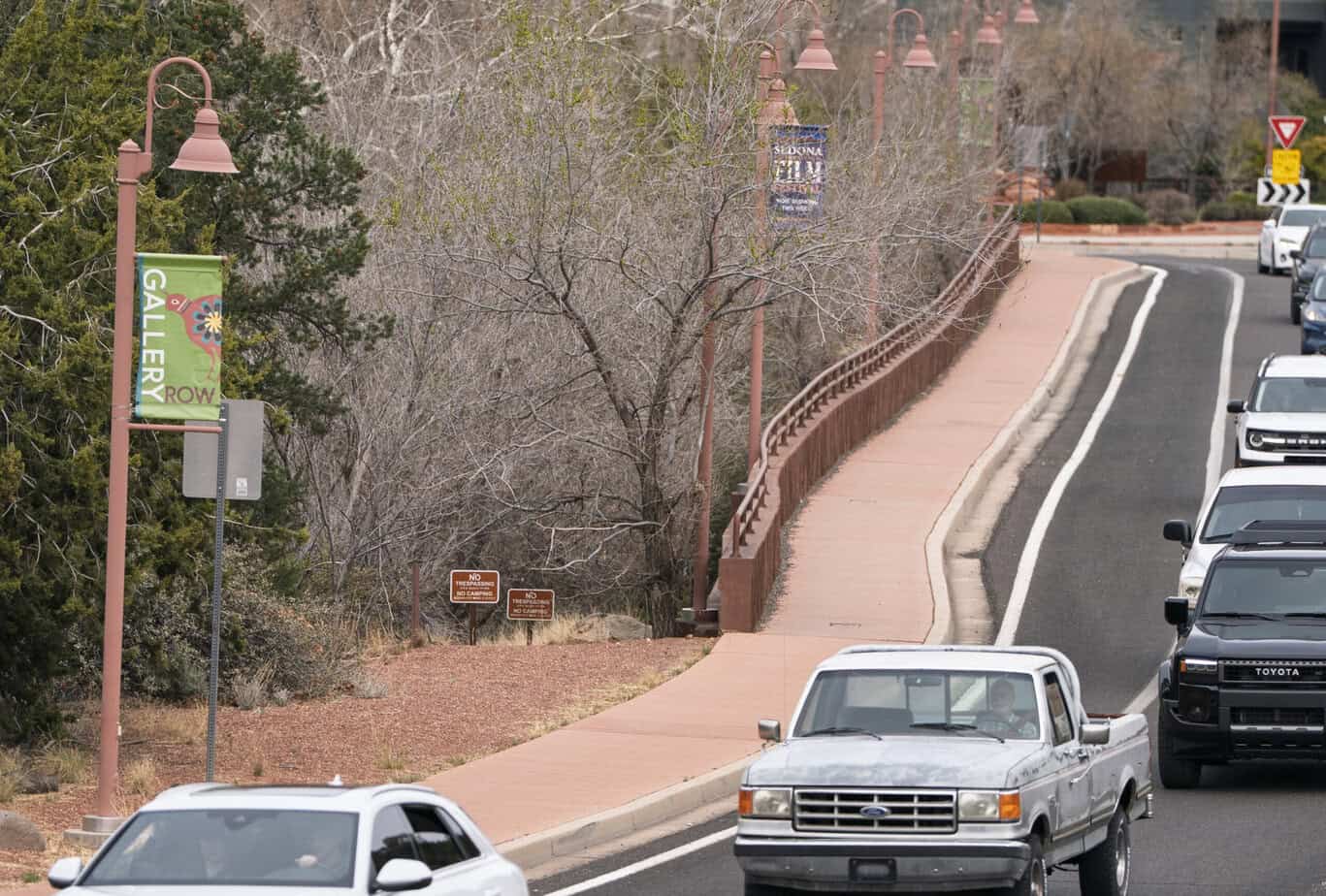
A temporary flagpole was erected last week next to the Posse Grounds Pavilion at the Barbara Antonsen Memorial Park to gauge public opinion on a permanent flagpole. Photo by David Jolkovski/Larson Newspapers.

The Sedona City Council considered the possible installation of a permanent flagpole at Posse Grounds Park on Oct. 22, and will return to the question at some unspecified point in the future, after Mayor Scott Jablow and Councilwoman Kathy Kinsella moved to continue the proposal to avoid its being voted down in a possible 3-3 vote. Tied votes automatically fail.

The request for a permanent flagpole was initially made by Councilman Pete Furman, who was absent, and was presented to council by Jack Ross, president of the Sedona Area Veteran and Community Outreach nonprofit.

“There was fears that it could block a view that’s called the million-dollar view during weddings,” Ross said, but added that SAVCO members and Parks and Recreation Department coordinator Jason Vargo had been able to agree on a location considered to be minimally obstructive.

“Our hope is that the city would procure the flagpole, city maintenance would install it and we, SAVCO, would work with parks and recreation to maintain it,” Ross explained. He proposed a 30-foot-tall flagpole with a light “for about $2,800,” flying four-foot-by-six-foot flags that would have to be replaced every six months.

“This happens to be the same height as the one at the military park,” Ross said, and pointed out that the temporary flagpole SAVCO installed for a Memorial Day event had been 25 feet high. For comparison, the Barbara Antonsen Memorial Pavilion stands 24 feet 7 inches tall. Ross also urged buying a model with an internal hoist: “If everything’s on the outside, there’s a danger of kids coming by at night and go, hey, let’s get a flag from Sedona.”

“Why can’t you just have it at — whatever the approved level is — height?” outgoing Councilwoman Jessica Williamson asked. City code limits flagpoles to 22 feet in height.

“How small do you want it? The pavilion’s pretty big,” Ross said. “The flag is pretty big, four by six, so the smaller the flagpole, it just doesn’t look right, like being on a fishing pole … 25 is pretty small.”

Councilwoman Kathy Kinsella was concerned about the light’s appearance as viewed from neighboring homes.

“It would blend right in about the same height that they can see the pavilion from a lot of those houses,” Parks and Recreation Manager Josh Frewin said. “It would definitely be visible from those homes. So the light would be visible to homes below as well.”

“It’s not a light that spreads out,” Ross said.

“Have you actually talked to the people who will have to look at this from their back porches?” Councilwoman Melissa Dunn asked. “Even though it points down, it still reflects out.”

“We have not, for that,” Frewin said. He said an alternative would be to install a permanent pole without flying a flag except during events, but “in my opinion, just having the pole stand there by itself for 363 days of the year would be a worse look.”

“I certainly support a flag at this location … but why wouldn’t we just go with a 22-foot limitation?” Kinsella said.

“They’re built in five-foot increments,” Ross said.

“So you’re saying that the 22-foot limitation would actually mean that we would have a 20-foot pole and that you feel that’s insufficient?” Kinsella asked.

“Certainly,” Ross said. He then agreed that a 25-foot permanent pole would be “acceptable” and suggested the possibility of flying a second flag from the pole “if you wanted more use out of that.”

“I prefer the option of having the temporary flag put up on occasions where it’s appropriate,” Williamson said. “I would only support up to 25” for a permanent pole.

Kinsella agreed, stating that she would not be able to support a permanent installation due to the lack of neighborhood outreach so far.

“I support the ask as asked, no exceptions or need for alterations,” Councilman Brian Fultz said.

“Dark sky-compliant lighting doesn’t matter if the flags themselves are meant to be reflective,” Dunn said. “I am concerned about reflectivity at night, because that is a violation of dark sky to some extent … there are a lot of homes that are nearby and would see it. I would assume they wouldn’t be offended but I don’t know that, so I would appreciate if we just have a conversation with the neighborhood.”

Jablow and Vice Mayor Holli Ploog both supported the SAVCO proposal as written.

“I don’t see a difference between 25 or 30,” Jablow said. He then proposed withdrawing the item for the moment because “I don’t want it to fail.”

“A motion to continue the item would be best,” City Attorney Kurt Christianson said, which was then proposed by Kinsella and seconded by Williamson.

Dunn asked to clarify that the vote was postponed due to Furman’s absence.

“That’s correct, ” Ploog said.

“It was Pete’s idea,” Jablow said.

Council approved the motion to continue 4-2, with Fultz and Ploog opposed.

City moves to swat private sport courts

Pete Furman · October 29, 2024 ·

City moves to swat private sport courts – Sedona Red Rock News

Residents play pickleball at one of the city of Sedona’s new pickleball courts at Posse Grounds Park after the official opening on Oct. 22, less than two weeks after the Sedona City Council, whose members had unanimously approved the construction of the courts at a cost of $1.6 million, directed city staff to begin drafting a new ordinance aimed at limiting or preventing the existence of pickleball courts on private property. Photo by David Jolkovski/Larson Newspapers.

The Sedona City Council held a work session on Oct. 9 at which council members supported creating new regulations for pickleball courts located on private property.

The session followed complaints made by several Chapel area residents during the public comment period at the Sept. 24 City Council meeting. They objected to the ongoing construction of a private pickleball court in the neighborhood, stating that noise from pickleball play would be hazardous to their and their dogs’ health.

“Our current Land Development Code does not have any regulations and we have never had any regulations in regard to sport courts,” Planning Manager Cari Meyer said. “We generally consider them in same way we’ve considered concrete patios, or concrete slabs in a backyard, which are allowed without a permit,” although she noted that additional construction features, such as fences, grading or lighting, might require permits.

“Since we don’t have a permit specifically for a sport court, we don’t have a record of necessarily how many there are in the city,” Meyer continued. Using aerial photography, city staff counted two existing sports courts at Los Abrigados Resort and Poco Diablo Resort, four in homeowners’ associations and seven at private homes. Five of the courts at private homes are for tennis, one is for basketball and one is for pickleball.

“We also looked at the code enforcement history of each of these properties, and we did not find anything related to noise or the use of the courts,” Meyer said.

“Anything that’s constructed that’s legally permitted at the time it’s constructed would be grandfathered,” City Attorney Kurt Christianson stated. “If, for example, the city decides to adopt a new setback of 200 feet from property lines, all existing courts are not going to have to be torn out.”

With regard to noise, Meyer pointed out that “the city obviously has just overarching noise regulations for the entire community, regardless of what you’re doing on the property.”

Christianson added that an additional code provision allows subjective citation of individuals if they produce “any noise that disturbs the peace and quiet of a neighborhood.”

“As Cari mentioned, apparently none of the neighbors have complained about the existing courts,” Christianson said.

“That is an enforcement opportunity that we do have even for any of these grandfathered properties,” Councilman Brian Fultz said. He asked if the city could impose an emergency moratorium on court construction, possibly using the mayor’s emergency powers, “so we don’t have anybody hurrying up and coming in and trying to get another court started … Is this an emergency of the health and welllbeing of the public?”

“We don’t have any true emergency here,” Christianson said. “The regulations that are being proposed by Public Works and the City Attorney’s Office could support would be reasonable time, place and manner restrictions, and not outright bans anyway, because that’s all the data supports.”

“Is there any way that we would be able to require people to put in mitigation for existing courts?” Councilwoman Melissa Dunn asked.

“Generally, no,” Christianson said. “Generally, they’re going to be grandfathered.”

“If no one has complained about the existing courts, wouldn’t it be a stretch to require mitigation for something that isn’t an issue?” outgoing Councilwoman Jessica Williamson asked.

“We need to think comprehensively about this,” Councilwoman Kathy Kinsella said, suggesting that council needed to head off any possible future changes in residents’ sporting preferences or recreation patterns that could require future regulation.

“I’m worried about small tournaments in places with multiple courts,” Kinsella added before proposing limits on the number of courts an individual could have.

The sound intensity from a point source of sound will obey the inverse square law if there are no reflections or reverberation. A plot of this intensity drop shows that it drops off rapidly.
Graphic courtesy of Georgia State University

Resident Becky Hofer had claimed at the Sept. 24 meeting that noise of 110 decibels was recorded “at the paddle,” and reiterated the claim on Oct. 9. Per the inverse square law, a 110 dB sound diminishes at a distance of 26.35 feet to 60 dB, the city’s noise limit for residential areas as measured “at the exterior line of a property.”

A plot of the drop of sound intensity according to the inverse square law emphasizes the rapid loss associated with the inverse square law. This plot shows the points connected by straight lines but the actual drop is a smooth curve between the points
Graphic courtesy of Georgia State University

Resident Craig Swanson said pickleball was “qualitatively and quantitatively” different from other sports and described the noise as “unbearable,” and said the city could be sued by somebody “who’s driven crazy” by the noise.

The decibel scale is logarithmic, not linear. That means a sound that measures 40 dB is not twice as loud as a sound measuring 20 dB, but rather, it is 100 times louder. A noise that measures 100 dB at the source but 60 dB 26 feet away is not 40% less loud but rather 10,000 times less loud.

“I don’t want to prohibit people from having fun,” Williamson said. “We have to accept a certain amount of noise in our neighborhood. I don’t believe anybody has to accept pickleball.” She then called pickleball play “unique assaults” and “insufferable” and said council should avoid complications by regulating pickleball courts and play only, rather than sport courts in general.

Furman called for a focus on “percussive noise sports” and termed pickleball “particularly disturbing,” while Kinsella suggested additional restrictions that she said would be “reasonable regulations,” including setback requirements for courts and requirements for size, screening and lighting.

“I want us to help the neighbors as aggressively as possible to require mitigation and if necessary to assist in the property owner being cited,” Fultz said, and supported more pickleball-focused regulation “as quickly as possible.” Dunn said she wanted a “broader” ordinance to cover all percussive sports.

“I’d like to get ahead of the curve on pickleball,” Vice Mayor Holli Ploog said, saying that she was “completely in support” of more regulation.

“Tennis is damn annoying, but so is basketball,” said Mayor Scott Jablow, who also said he wanted noise limits and setback requirements. “That noise of the pickleball is so much more invasive.”

Part of the city’s agenda packet read, “While much of the discussion has been about pickleball, the city cannot single out ‘pickleball’ and adopted regulations would apply to all sport courts.”

Ploog supported a future inquiry into whether the city should lower its daytime and nighttime noise limits to 55 and 45 dB, respectively. Council “should evaluate whether or not our noise ordinance code … actually fits what we want for our community,” Dunn added.

Meyer said that it would take staff three to four months to draft more restrictive sport court regulations and go through the process required to amend the Land Development Code to enact those regulations.

The mayor and city staff officially opened eight pickleball courts at Posse Grounds Park on Oct. 22.

RESULTS: CITY COUNCIL MEETING SUMMARY, WEEK OF 10/20/24

Pete Furman · October 29, 2024 ·

10/22/24: City Council. 4:30p @ Council Chambers.
8.a. Coconino County Expenditure Limit. PRESENTATION ONLY.
8.b. Sedona Sister Cities. DURECTED STAFF TO DEVELOP GUIDELINES FOR STAFF SUPPORT.
8.c. Wastewater Treatment Plant Construction Contract. $4.097M. APPROVED 6-0 (Furman absent).
8.d. Flagpole at Posse Grounds Park. MOTION TO CONTINUE TO ANOTHER MEETING APPROVED 6-0 (Furman Absent).
8.e. Traffic Testing of the Y and SR 179 Undercrossing. PRESENTATION ONLY.
City Council Meeting | City Calendar | City of Sedona (sedonaaz.gov)

10/23/24: City Council Executive Session. 1:00p @ Vultee Conference Room
3.a. Interview Candidates for City Lobbyist.
City Council Meeting – Executive Session | City Calendar | City of Sedona (sedonaaz.gov)

10/23/24: City Council Work Session. 3:00p @ Council Chambers.
3.a. City Collaboration with Arizona Water on Local water Resource Assessment.
Agendas and Documents | City of Sedona (sedonaaz.gov)


  • Share on Twitter Share on Twitter
  • Share on Facebook Share on Facebook
  • Share via Email Share via Email

Be sure to check back after the meetings to read a summary: Pete’s Sedona City Meeting Summaries | Sedona City Councilmember Pete Furman (sedonapete.com)

Sedona’s outrageously high pay-to-play development fees dooms workers, modest housing and workforce housing

Pete Furman · October 21, 2024 ·

Sedona’s outrageously high pay-to-play development fees dooms workers, modest housing and workforce housing – Sedona Red Rock News

Last month Sedona City Council heard a pitch from a Baltimore-based consulting firm about reasons to jack up Sedona’s already-high development fees. Council members seemed aghast to learn the fees we’re charged to build a home in Sedona are far and away more expensive than those charged by any other local community that the out-of-state consultant investigated.

Did council suddenly find its sanity about the sheer cost of building a home in Sedona?

“We were highest to begin with and we are three times higher after the proposed fees,” Councilwoman Jessica Williamson said, while Councilwoman Kathy Kinsella said, “There will be reaction out there to those numbers,” and Councilman Pete Furman adroitly remarked, “When you look at this stuff, it sure looks like we’re trying to prevent housing.”

Surely their shock meant that council would look at reducing some of these intimidating costs to build a single-family home within city limits. After all, when running for office, our elected council members repeated that housing costs were a top concern — and their intention of doing something about it was one reason they asked for your vote.

Current Sedona City Council members discussing the need for housing in their election campaigns.

So that’s why it’s unfathomable that Sedona City Council members openly betrayed themselves on Tuesday, Oct. 8, when they voted unanimously to move forward on raising Sedona’s already atrocious development fees — and nearly double them. Council seems happy to hike these fees to bring the city a few more drops of income while Sedona’s families are struggling under record inflation, reminiscent of when council voted in 2021 to make Sedona’s supposedly temporary half-cent sales tax hike permanent — disproportionately affecting the working class and seniors on fixed incomes.

Council wants to squeeze every dime it can from residents, tourists, property owners and, most offensively, every working-class Sedonan, renter, senior and working family surviving on limited incomes.

Council’s plan to jack up building costs is obscene, but it fits with their apparent goal of killing a Sedona community where the wealthy, middle class and workers can all find a comfortable balance and instead turning Sedona into the next Aspen, Telluride or Scottsdale.

Council apparently wants to legally steal money via a “pay for play” taxation scheme to score points with campaign donors by building pickleball courts, shifting police away from crime to enforce an OHV speed limit in a single neighborhood lined with already-expensive homes, paying a traffic guard to halt “riff-raff” from driving down Back o’ Beyond Road with its multi-million-dollar estates, or building sidewalks in some of Sedona’s wealthiest neighborhoods — which second-home owners rarely use on the occasions when they are here.

Even the simplest floor plan and the most basic amenities for a new, modest house will be unobtainable for workers, thanks to the massive taxes imposed on them to fill the city’s swelling coffers. Nearly every council member owns a home worth over a million dollars, so why would they have to worry about adding to the cost of building workforce housing or a single-family home?

Meanwhile, Sedona’s poor and middle-class neighborhoods — whose residents don’t have excess income to donate to mayoral and council member reelection campaigns — still have asphalt abutting private property and are still stepping aside for cars driven by fellow workers heading home after a hot day of serving the very folks who are intentionally ignoring their neighborhoods.

The city isn’t building a recreation center or parks.

The city owns no fire department.

Police staffing is stagnant, but somehow the city is still hiring more and more administrators to run programs with marginal community benefit.

The higher fees will make short-term rentals more likely, not less. High development fees will transform Sedona from a financially-diverse community into one where only the uber-wealthy can afford to pay to play, leading to old homes being torn down to build McMansions, many of which will be built as short-term rentals — the only profitable industry Sedona has besides tourism.

This cynical, cyclical feedback loop will strip away Sedona’s less valuable homes on increasingly expensive parcels one by one until Sedona is nothing but gated communities locking out Sedona’s workforce, who will have moved to surrounding communities. In a few years, council won’t have to worry about pesky biennial campaign demands for “workforce housing,” because Sedona won’t be home to any workers who can afford the astronomical rents for 4,000- square-foot palatial villas. Sedona’s businesses will have to pay higher wages to make working in our city worth the long drive from Camp Verde, Rimrock, Cottonwood, Cornville and Clarkdale, passing on those expenses to customers.

Every election cycle, council candidates pretend to care about Sedona’s working class, but this vote means they can kiss any “workforce housing” goodbye — not that any sane Sedona resident ever thought it would be possible anyway.

“When you look at this stuff, it sure looks like we’re trying to prevent housing,” Furman said.

No, councilman, you and your six colleagues aren’t “trying to prevent housing” — you are preventing housing.

Council can still do the right thing and claw back these development fees, especially for single-family homes and housing complexes, to encourage builders to make smaller homes for renters that are worth the expense to build them.

  • « Go to Previous Page
  • Go to page 1
  • Interim pages omitted …
  • Go to page 14
  • Go to page 15
  • Go to page 16
  • Go to page 17
  • Go to page 18
  • Interim pages omitted …
  • Go to page 35
  • Go to Next Page »

FISCAL RESPONSIBILITY • HONESTY • OPEN GOVERNMENT

  • Email
  • Facebook
  • Instagram
  • LinkedIn
  • YouTube

Sedona City Councilmember Pete Furman

Copyright © 2026 | Paid for by Pete Furman | Website by Pivot Strategies, Inc.

  • Home
  • About Pete
  • In the News
  • City Meetings
  • Contact Pete