• Skip to primary navigation
  • Skip to main content

Sedona City Councilmember Pete Furman

  • Home
  • About Pete
    • Meet Pete
    • Pete’s Priorities
    • Pete’s Perspectives
  • In the News
  • City Meetings
    • Upcoming Sedona City Meetings
    • Sedona City Meeting Summaries
  • Contact Pete
  • Show Search
Hide Search

Pete Furman

Council votes 6-1 to proceed with annexation

Pete Furman · December 18, 2024 ·

Council votes 6-1 to proceed with annexation – Sedona Red Rock News

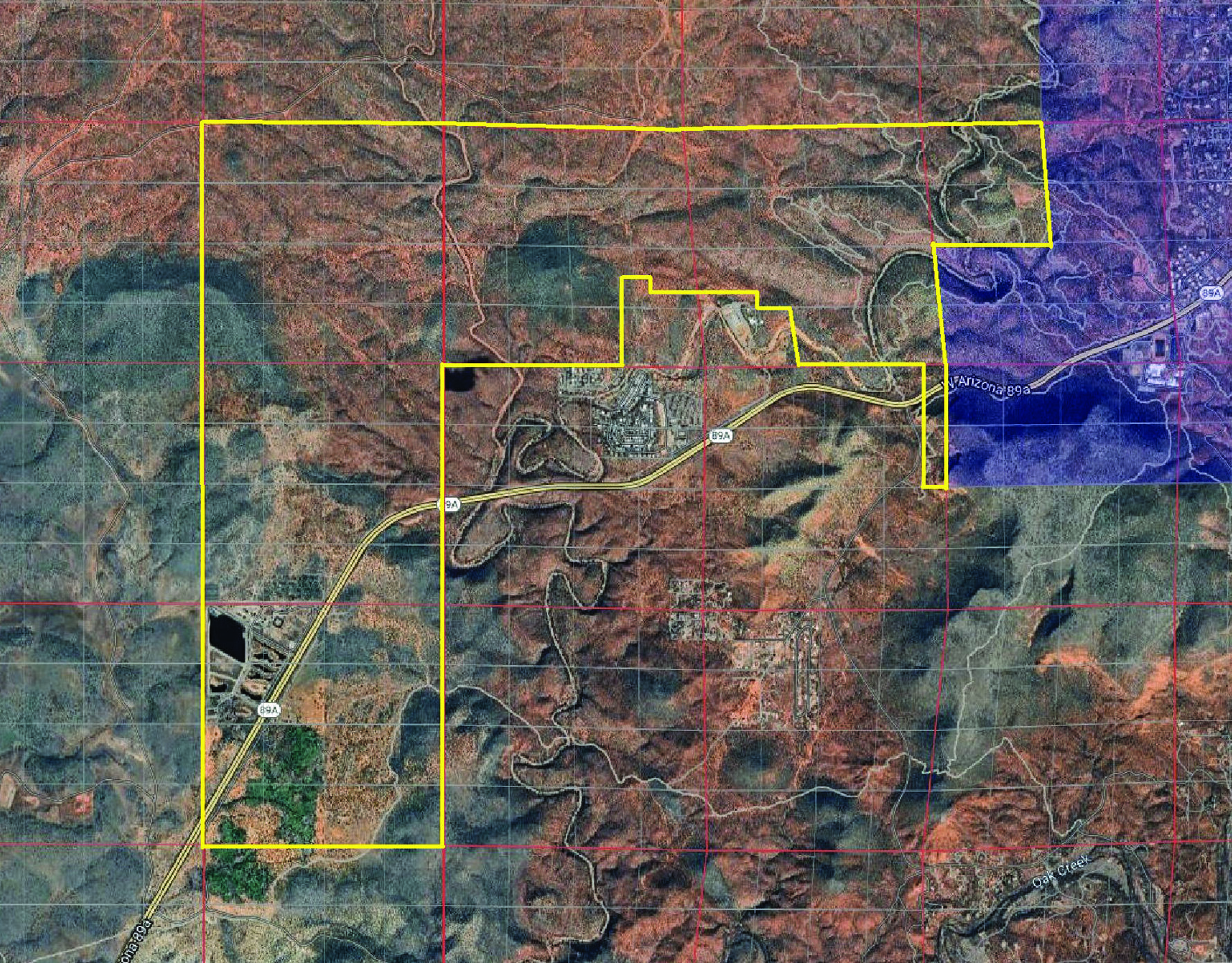
The Sedona City Council voted 6-1 to approve filing a petition with the Yavapai County Recorder to annex approximately 3,422 acres of land, including the city’s Wastewater Treatment Plant and neighboring city-owned property, known colloquially as “the Dells,” into city limits, increasing the city’s size by 29%. By law, annexed lands must be contiguous with the existing boundaries of a municipality, resulting in the “L” shape.

Sedona City Councilman Pete Furman said he was trying not to use the word “sprawl,” but he did eventually use it during the Sedona City Council’s discussion on Tuesday, Dec. 10, of annexing 3,422 acres of mainly Coconino National Forest land west of Sedona.

The annexation would increase the city’s size by 29%.

City Attorney Kurt Christianson explained that the proposed annexation would extend Sedona’s western boundary by approximately three-anda-half miles further west, and then three and a quarter miles south, across an L-shaped area occupied entirely by the Coconino National Forest, Arizona Department of Transportation right-of-way and the city’s Wastewater Reclamation Plant and undeveloped property colloquially known as “the Dells.” State law does not permit municipalities to annex islands, so state contiguity requirements resulted in this shape in order for the city to connect the desired parcels to its existing boundaries.

“There are no other proposed annexations of any real property, although it does touch the Sedona Shadows development,” Christianson said. “No one in Sedona Shadows or Sedona Pines or El Rojo Grande Ranch, their property, is proposed to be annexed in this.”

“It’s literally just a function of bringing in our own owned property within the city limits,” Councilman Brian Fultz said.

“It’s not like we can develop it. We don’t own it,” Christianson said. “It’s just a way to get to the wastewater treatment plant.”

“We did a pretty good job talking about ‘the what’ and ‘the ‘how’ but not ‘the why,’” Furman said. “You leave me scratching my head about what ‘the why’ is, what the problem is we’re working to solve.”

“To show other cities that we are interested in this area and we don’t want other cities coming in to encroach on it,” Christianson said. “Two, it’s to facilitate the development of the city’s transit and maintenance operations facility … This would just make clear that it’s part of the city’s — that [Yavapai] County has no authority over it anymore.”

The proposed transit facility has not yet been approved by council, while outgoing City Transit Administrator Robert Weber has repeatedly referred to the city’s transit program as experimental and said it could shut down due to lack of need.

City Manager Anette Spickard declined to comment on what steps the city would take if it annexed the land but council shutters the transit program.

“Has the county interfered with, or unexpectedly or unnecessarily complicated the work that we’ve done at the water treatment plant?” Furman asked.

“That’s exactly the question,” Christianson said. “We told them we were going to be building this, and they said under what authority can you just do that. It was explained to them, they said we disagree … It was explained that we have this IGA [intergovernmental agreement] with you that says we can do this, and they said that’s inapplicable … We just kind of went back and forth.”

Christianson described staff expenditure on the project so far as “a significant amount of staff time,” “many weeks’ work” and “the greater part of the summer.”

Public Comment

Four Sunset Hills residents spoke on concerns related to having the city’s boundary adjoining that of their community.

“Why suddenly do you feel a need to go out and encompass that?” Trish Janke asked. “It’s been working fine the way it is; why suddenly is there a need for a change?”

“We are still concerned about the vagueness of what’s going to come in the future,” Bonnie Johnson said. “Can we get any assurances of no development back there in the future?”

Development

“The city cannot develop Coconino National Forest,” Christianson said. “The only way anyone could develop Coconino National Forest … would be, I believe, through a land exchange. A land exchange means that you own National Forest property somewhere else and you’re wanting to exchange it with the National Forest — they generally will want more valuable property for less valuable.”

“Often, a land exchange has to be approved by an act of Congress,” Christianson added.

The Red Rock Ranger District has had an effective moratorium on land exchanges since 1998. Land exchanges are rare, such as the one that transferred the property for the future Sedona Cultural Park to a nonprofit in 1998; the 2005 auction of 21 acres of the old Sedona Ranger Station on Brewer Road for $8.4 million; a proposed swap of 369 acres owned by Yavapai County near Cottonwood in 2018 for 80 USFS acres in Cornville; and a recent swap with the Yavapai-Apache Nation to trade 4,782 acres of lands the tribe bought in the Prescott, Coconino, Kaibab and Apache-Sitgreaves national forests for 3,207 acres of USFS land adjacent to tribal lands.

“I really fail to see the necessity of making this effort today,” Furman said. “The city’s cost structure is largely determined by its size … expanding our footprint will likely have a significant impact on future budgets.”

“It’s actually in our interest to have this land be part of the city and under our control,” Vice Mayor Holli Ploog said.

“It is about us having control of what we need to build out there,” Councilwoman Melissa Dunn said.

Councilwoman Kathy Kinsella said she would be more comfortable with Sedona controlling the zoning instead of Yavapai County should a U.S. Forest Service land exchange take place at some point in the future.

“Who’s the best stewards for this area?” Kinsella said. “I think that’s the city of Sedona.”

Furman, Kinsella and Mayor Scott Jablow all rejected the idea of near-term development of the Dells property regardless of whether the annexation went ahead.

“Stuff this genie back in the bottle,” Furman said.

“I think that the way to protect the Dells is by making sure that it comes into the city’s jurisdiction,” Kinsella said. “It’s one of the few really untouched and pure lands that we have … It’s directly on the water, the creek is right down there, it’s riparian.”

It is unclear as of press time what creek Kinsella meant; Oak Creek is approximately 1.4 miles from the Dells at its nearest point and the Verde River is 7.2 miles away. The Dells is currently used for spraying of the treated effluent from the city sewage plant and as leased pasture for cattle.

Council voted 6-1 to proceed with the annexation process, with Furman opposed.

A public hearing on the proposed annexation is currently scheduled for Jan. 14. Council can halt the annexation process at any point during the process.

Council looks at options to move visible homeless elsewhere

Pete Furman · December 8, 2024 ·

Council looks at options to move visible homeless elsewhere – Sedona Red Rock News

Hadassah Kain and Jordan Blanchard sit in Kain’s minivan on Monday, June 28, 2021. Kain and Blanchard, who both work in the area, have struggled to find stable housing in Sedona. Both at times have had to camp on U.S. National Forest land while working. Blanchard has lived in Sedona since he was 2. Kain was living in her van when Coconino National Forest evacuated all campers last week. David Jolkovski/Larson Newspapers

PUBLISHERS NOTE: This story was updated at 8:40AM on 12/8/24 to remove an inaccurate and out of context quote by Sedona Councilman Pete Furman regarding affordable and workforce housing. This was a Sedona Red Rock News editorial error. We apologize to councilman Furman for any issues this error may have caused.

The Sedona City Council heard a presentation from consultants Jonathan Danforth and Matt White of Viam Advising, with commentary from Sedona Deputy Police Chief and newly-elected Cottonwood City Councilman Christopher Dowell, during its Nov. 26 consideration of the city’s ongoing assessment of homelessness in the Verde Valley.

Per Sedona Housing Manager Jeanne Frieder, the assessment is intended to precede the development of a city strategic plan to reduce homelessness.

“We believe there are roughly 600 individual households or persons that are experiencing homelessness during the course of the year,” White said. “Unfortunately, we don’t have defensible, concrete data sources to draw from, so we had to create this number.”

Their sources for the estimate included the Homeless Information Management System, a set of interlinked federal databases used to track homeless individuals who have enrolled; working with local food banks to track their clients; and discussions with local officials who have contact with the homeless, including police and U.S. Forest Service personnel.

“There aren’t a lot of homeless services for people to participate in, so a service-based enumeration is challenging,” White said.

Danforth and White then forecast a 6% per year increase in homelessness in the Verde Valley over the next five years based on historical rates of increase within Yavapai County, which they predicted would bring the total number of homeless people in the Verde Valley to 800. The Verde Valley has a population of approximately 67,000 and Yavapai County has a population of 236,209.

Using a nationally-developed typology for categorizing homelessness, White estimated that 60% of the homeless would be experiencing “transitional” homelessness for less than three months, while another 30% would be cycling in and out of “episodic” homelessness over the course of a year.

The remainder of the homeless population, White said, consisting of about 60 people across the Verde Valley experiencing chronic homelessness, is “a relatively small proportion of the total homeless population” but “the most visible … there’s more opportunity for them to be seen across the community … and there’s always a co-occurring disability.”

“Research shows that homelessness is driven by a lack of affordability and availability of housing,” Danforth said. Regarding mental health or substance use, he said that “research does not show that those are drivers of homelessness; those are exacerbating factors for homelessness.”

In Sedona and the Verde Valley, White said, “many of the people we spoke to — at least half — are longtime residents of the area” who have run into family, health or housing problems.

However, Danforth said, moving on to recommended actions for coping with homelessness, “housing development is not an immediate answer.”

White stressed “preventing the inflow of newly homeless” through services such as vehicle repair, employment assistance, modest financial assistance and “supporting the relocation of people to other jurisdictions” by providing them with moving assistance to other areas where they might have family members to support them.

“I would say that many of the people that we spoke to would be willing to have the conversation,” White said of relocation.

To reduce existing homelessness — “more people on the streets and in public spaces that’s not consistent with your vision for Sedona and the Verde Valley” — White continued, the city could offer rent subsidies, inhome support and outreach and other services that do not currently exist.

By providing services, White said, “you’re actually reducing visible homelessness in the community.”

Council Questions

Mayor Scott Jablow asked if homeless individuals were liable to relocate to an area where services were available.

“There’s not a magnet effect, or this attraction effect, that you would expect,” White said. “People experiencing homelessness are experiencing extreme poverty and often lack executive function … it’s very difficult for people to think, ‘I’m going to relocate’ … and if they did have that thought, they don’t have the economic means.”

White added that directing spending toward helping the transitional homeless would give the city the best bang for its buck, but “if your interest is reducing the visible homeless, the people that are seen on the street that are flying the signs, that are the reason you’re getting calls from constituents, what feels to be so inconsistent with the character of Sedona,” then spending money on the transitionally homeless would have little effect.

Communities that attempted to penalize homelessness with citations and other punitive measures, White noted, were discovered to have “experienced a slight uptick in homelessness” in a recent study.

“Can you do a little bit of both?” Councilman Derek Pfaff asked. “Carrot and the stick approach, does that work well?”

Danforth replied that police action only had a long-term effect on homelessness numbers when housing was available.

Councilman Brian Fultz asked about the status of city staff’s proposed cold weather voucher program to put homeless individuals up in local hotels.

“We haven’t been able to create a partnership with a hotel,” Frieder said. “To date, we have had zero interest.”

Fultz then asked about the estimated $11,817,363 annual cost of a regional homelessness prevention and support system in the report.

“Why is that a good expenditure of resources?” Fultz asked. “How should we be thinking about that as a benefit to the community? … Selling it is 95% of the challenge.”

Danforth said that the benefit would consist of getting the chronic, visible homeless off the streets, while White said the number was intended “to start the conversation about what is the community willing to live with.”

“You have to build community will as part of this effort,” Danforth said. “When you have political will … that is a really powerful statement that communities usually respond well to.”

The city’s proposal to create a homeless camp at the Sedona Cultural Park was rejected by 64% of voters in a referendum on Nov. 5.

“I don’t want us to get too hung up on, this is the price per homeless person,” Pfaff said, adding that having services would “take some pressure off the police department. It’s going to improve the peace of mind of our residents who are no longer going into stores and having people standing in front of the store asking for money. You really can’t put a price on this.”

Cottonwood Input

“It doesn’t do any good to write them 40 tickets and put them in jail,” Dowell said, based on his experience as a police officer and former interim police chief in Cottonwood. He argued for the importance of more coordination of existing community resources, and of a voucher program, which he said “goes a long way … and we don’t look, as a city, like we don’t care about them.”

Dowell detailed a Cottonwood effort to get businesses to give police officers advance permission to trespass anyone from their property so that officers do not have to request a managers’ permission each time.

Sedona Councilman Pete Furman asked about the connection between panhandling and homelessness, and Dowell replied that about 10% of panhandlers “are people who have resources.”

“The transitional people, they’re out trying to make a living,” Dowell said. As for others, “they’re doing it for their fix or maybe to buy food,” not to pay rent or child support and discussed “professional” panhandlers who he said could make $60 an hour.

“This is America. You’re free to do what you want to do,” Dowell said. “You want to live on the street, live on the street. You can do all these things. What you can’t do is you can’t affect somebody else’s quality of life. Once you do that, now there’s consequences.”

Public Comment

“Why are we counting homelessness in the Verde Valley? I can’t think of seven more disparate cities,” Sedona resident Bill Noonan said. “It’s probably conceptually incorrect to be looking at this.”

“Your consultant is wrong; spending money on homelessness does in fact increase homelessness,” Noonan continued. “I think we need look no further than California, which spent $24 billion over a five-year period and managed to increase homelessness by 25% … National opinion has turned decisively against programs like the ones recommended by your consultants.”

Sedona resident Suzanne Strauss said the study “inaccurately combines data from Sedona with the entire Verde Valley,” uses “flawed methodology” and “outdated data” and “perpetuates a false narrative … harmful to Sedona’s reputation as a beautiful and welcoming destination.”

“The residents have spoken two to one on this issue on Nov. 5 in order to rein in the out-of-control, out-of-touch council and staff and its out-of-control spending,” Strauss added. “It’s studies like these that give credence to no home rule.”

Following the meeting, Frieder said that city staff have no current plans to repeal the city’s anticamping ordinance, to use vacant city buildings to house the homeless, previously suggested by Fultz, or to create a voucher program to pay private individuals with spare rooms to take in homeless individuals.

CITY COUNCIL MEETING SUMMARY, WEEK OF 11/26/24

Pete Furman · November 27, 2024 ·

11/26/24 CITY COUNCIL.
3.f. Settlement Agreement on Forest Road with Farshid Paydar. $660K. APPROVED ON CONSENT. 7-0.
8.a. Development Impact Fees. CONTINUE DISCUSSION ON 12/10/24.
8.b. Sedona Homeless Needs Assessment. CONTINUE DISCUSSION IN JANUARY, 2025.
8.c. Consolidated Fee Schedule. APPROVED, 7-0.
Agendas and Documents | City of Sedona


  • Share on Twitter Share on Twitter
  • Share on Facebook Share on Facebook
  • Share via Email Share via Email

Preview future meetings at: Upcoming Sedona City Meetings | Sedona City Councilmember Pete Furman (sedonapete.com)
Sedona’s new fees expected to lead the state

Pete Furman · November 25, 2024 ·

Sedona’s new fees expected to lead the state – Sedona Red Rock News

Arizona Gov. Katie Hobbs, second from left, joins local officials during a groundbreaking ceremony for the Sycamore Vista affordable housing complex on Wednesday, Oct. 16, in Camp Verde. Unlike Sedona, Camp Verde does not charge development impact fees that are among the highest in the state. Photo by David Jolkovski/Larson Newspapers.

The Sedona City Council directed staff to continue with the process of possibly increasing development impact fees on Tuesday, Nov. 12, after hearing a staff report explaining that Sedona’s DIF fees were higher than those compared across Arizona.

No members of the public addressed council on the subject.

Finance director Barbara Whitehorn said staff had compared Sedona’s proposed fees against those of Flagstaff, Gilbert, Fountain Hills, Apache Junction and Kingman, which she said are “very different from us.”

“Apples to oranges is really what we found,” Whitehorn said. “A lot of cities don’t have development fees at all,” such as Cottonwood and Camp Verde, which use grants and capital plans to fund their capital projects, while other jurisdictions employ dedicated taxes, investment revenue or other sources. Whitehorn noted that Flagstaff uses four different sales taxes to fund its transit program alone.

“That’s certainly an option for a community, but it does mean that you’re using revenue from other revenue streams,” Whitehorn said. “It’s a philosophical difference.”

She described Gilbert, a Phoenix suburb with a population of 267,918, as having development fees “much closer to the proposed fees for the city of Sedona.” Fountain Hills, another suburb of Phoenix, with a population of 23,820, has fees that Whitehorn said were “fairly lower.”

“Their fees are also quite low,” Whitehorn said of Kingman, population 32,689, which revoked its development impact fees in 2011. “They felt like the impact fees might be influencing the decision of developers not to develop in Kingman.”

“I do think there was some good logic to this,” Whitehorn said in regard to Sedona’s proposed increase, which would more than double existing fees, if passed.

Responding to Councilman Brian Fultz, Whitehorn said fees are intended to cover a portion of city spending on capital programs. She estimated that the fee-eligible portion of capital spending over the next 10 years will amount to $3.1 million for police projects, $4.7 million for parks projects and $12.3 million for streets projects, for a total of $20.1 million.

City Manager Anette Spickard previously said on Aug. 13 that the city collects about $615,000 per year in development impact fees, or 0.58% of the city’s $106.2 million current budget.

According to the city’s fiscal year 2025 budget, total spending on capital projects for the next 10 years will be $220,533,880, up from $51.4 million for a six-year capital plan in FY15. The largest components of this will be $79.9 million for street reconstruction projects and $64.3 million for a transit system.

“We have been paying for street improvements through the general fund,” Vice Mayor Holli Ploog said.

Whitehorn said that a fee increase would only cause “less of an impact to the general fund. I don’t know how significant that will be.”

“I’m not sure I would equate less funding with declining service,” Ploog said.

“You got more people using the same resources, it’s a declining level of service,” Councilman Pete Furman said.

Newly-elected Councilman Derek Pfaff suggested that the city “raise the fees to what we can get … and then, on a case-by-case basis, we’ll judge whether the city should be paying” to make sure the fees fall more heavily on less “desirable” projects. The city cannot waive development impact fees, but it can pay them on behalf of a property owner, if council determines a project offers a public benefit.

Furman said that he was leaning toward Pfaff’s proposal of “stroking a check on projects that we want … rather than mess with the math here.”

“That’s kind of the simplest way to get where we want to go,” Furman said.

“It frankly feels more punitive at the low end,” Fultz said. “We are discouraging multi-family.” He added that he was “not concerned” about the fees’ effect on hotels. “I’m not sure I even care that much about single-family.”

“We’re pushing people out,” Ploog said, and stated that she would prefer lower fees for smaller units and higher fees for larger ones.

Councilwoman Kathy Kinsella said that the proposed fee structure would give a disproportionate advantage to builders of large single-family homes.

“I don’t think we’re going to work our way out of our housing problem in single-family homes,” Furman said. “It’s really about multi-family … and we need to communicate with the development community.”

“We’re not going to solve it with more small single-unit houses,” Councilwoman Melissa Dunn said, and added she did not want smaller, more affordable units to benefit from lower fees because she was afraid they would be used as short-term rentals.

Mayor Scott Jablow said limiting single-family development would make it more difficult for more retirees to move to Sedona.

Whitehorn also provided what she said were representative cost estimates for recently-permitted homes within Sedona, ranging from $300,000 for a 1,000-square-foot home to $1 million for a 2,050-square-foot home, exclusive of land costs. Whitehorn said that the proposed development fees accounted for between 3.1% and 1.5% of the homes’ costs, up from 1.5% and 0.7% at current levels, respectively.

Arriving at these conclusions, Whitehorn said, took some filtering.

“I didn’t use the ones that said it was only like $120 per square foot, because I found that unreasonably low,” Whitehorn said. “Steve [Mertes] and Laura [Stewart] in community development told me that it more likely was closer to like $700 a square foot.” In the end, she chose projects priced at between $280 and $490 per square foot.

Fultz pointed out that the updated fee on an accessory dwelling unit of the maximum size allowed, which is 750 square feet, would be $9,400.

Spickard told council that she would try to draft alternate proposals for multi-family fees “that you can pick at the next meeting,” which is currently planned for Tuesday, Nov. 26. Adoption of the proposed increased fees is scheduled for Tuesday, Jan. 14.

Council loosens some ADU rules, others take effect Jan. 1

Pete Furman · November 20, 2024 ·

Council loosens some ADU rules, others take effect Jan. 1 – Sedona Red Rock News

An accessory dwelling unit in Sedona on Nov. 13. Photo by David Jolkovski/Larson Newspapers.

The Sedona City Council began the process of bringing Sedona’s codes governing accessory dwelling units into conformity with recent updates to state law during its Nov. 12 meeting, with the remainder of the new state regulations set to go into effect automatically on Jan. 1.

Council unanimously approved changes to the Land Development Code that included altering the wording to refer to ADUs rather than “guest quarters”; eliminating the prohibition on kitchens in guest houses; striking the requirement that guest houses be “architecturally compatible” with the main house on a lot; and prohibiting ADUs from being used as shortterm rentals unless the owner’s primary residence is on the same lot, the owner resides there for more than six months each year and the owner has his vehicle and voter registration at that address.

Vice Mayor Holli Ploog asked about code allowances for “other forms of structures, such as a manufactured home or a tiny home.”

“If you can meet the International Residential Code building standards, you can build it,” Planning Manager Cari Meyer said.

In addition to the 962-page IRC, Sedona adopted 35 pages of amendments to the IRC, replacing a number of IRC standards with Sedona-specific requirements.

Community Development Director Steve Mertes said that manufactured homes would be eligible “as long as they’re a factory-built home that is built under the Arizona Department of Housing’s IRC compliance program, that is a structure that we would permit to be built … You were always able to build a factory-built home that is IRC compliant.”

“Except when people try to and then they get told they can’t,” Ploog said, adding, “There was an instance, if you recall, last year, where somebody was desperately trying to get approval for a manufactured home and it didn’t happen.”

Mertes suggested that property owners running into approval problems might not have chosen a home certified by Arizona Department of Housing, or that the owners could hire building inspectors at their own expense to stand by and watch their homes being built in a factory. “There are a couple of different options.”

“He didn’t have any particular home in mind,” Ploog said. “He had a lot of difficulty coming up with something that community development would approve. I don’t think we ever got there.”

“I don’t remember,” Mertes said. “Many times the issue is that the savings weren’t what they expected … We have never denied a home that was factory-built … that was IRC-compliant.”

In response to a question from Councilwoman Kathy Kinsella, Mertes estimated the smallest house that could meet all minimum code requirements would be “about 200 square feet.”

Councilwoman Melissa Dunn wanted to know how staff planned to control the number of people using each ADU or would find out that “the habitation is not meeting the desired rules.”

“We don’t get into how many people are sleeping there,” Meyer said.

“Do we have a significant number of noncompliant ADUs currently in the city?” Kinsella asked.

Meyer responded that any code enforcement cases on kitchens added after final inspection “would go away at this point. Generally that’s the main issue we run into in guesthouses.”

In discussion, council split on the merits of loosening ADU restrictions. Councilman Brian Fultz called for a turnkey program for qualified manufacturers “such that we can make it easy and less costly to get ADUs brought in on a trailer, dropped in by a crane.” Councilman Pete Furman agreed that he would support “preapproved plans that might help drive down the cost of structures,” as did Kinsella.

“I don’t think this goes far enough,” Ploog said. “We need to look at all forms of housing types and this doesn’t do that.”

“I can put a kitchen in now,” Mayor Scott Jablow said, referring to his guesthouse, but then commented, “They’re not safe if the property owner’s going to be installing them.”

Jablow added that he would support the language update “grudgingly” because the legislature had failed to adopt Sedona’s proposed ADU requirements.

“I don’t necessarily want to have somebody else’s house abutted right next to my property line,” Dunn said. “It leaves me feeling a little bit uncomfortable.”

Public Comment

Members of the public didn’t think the council’s proposed changes went far enough.

“You need to ask your staff to be more aggressive if you want to see a significant change going forward of more ADU houses built,” said Trevor Greco, a Colorado resident who owns property in Sedona. “There’s several unnecessary obstacles to build an ADU that make them basically not costeffective.” He said that the cost of a code-compliant ADU would be between $250,000 and $400,000. “As an investor, like ourselves, it really doesn’t make sense for us to build an ADU on an existing parcel. In addition, there are a lot of the smaller parcels within the city — with current setback requirements for ADUs, you’re not able to actually fit one in.”

“We have considered building an ADU on our property, but we’ve encountered obstacles and high cost, which have held us back,” Greco’s partner Marie Benedix said. “This is a shame. Sedona needs additional housing options, especially at the lower rents an ADU could afford … the biggest single change you could make would be to allow manufactured homes as ADUs in zoning districts where manufactured homes are already allowed for the main dwelling on the property. As the code currently is written, requiring a site-built ADU where the main dwelling is a manufactured home is an unnecessary hardship … Removing this obstacle could save about $150,000 on the cost of an ADU.”

“It can go a little farther,” Terry Gregory said. She recommended the city adopt smaller setback requirements. “This will allow the zoning department to work with homeowners to best site an ADU structure on a property … Sedona has a lot of unique lots … this is a big hurdle to overcome if you’re looking to place two structures on a parcel.”

“A reduction in permitting costs should strongly be considered … so that ADUs are affordable to build,” Gregory added.

“We have minimum lot sizes, we have setbacks, we have other restrictions that kind of prohibit the ability to develop a number of different plats with a tiny home on it,” Sean Smith said. “We’re going to have to address that at some point … It’s going to be hard to site those in clusters that make economic sense unless we have a land development code already set up for developers who can just come in and say, ‘Oh, hey, it’s by-right.’”

New State Law

House Bill 2720, which was signed into law on May 21, is now codified as Arizona Revised Statutes §9-461.18 and 9-500.39, which prohibit a municipality “that exercises zoning powers” from:

  • Prohibiting use of an ADU as a separate rental unit
  • Requiring family or financial relationships between occupants of both units
  • Requiring additional parking for ADUs or in-lieu fees
  • Requiring design correspondence between the structures
  • Imposing more severe code restrictions on ADUs than main houses
  • Setting setbacks for ADUs greater than five feet
  • Requiring street improvements as a condition of approval
  • Imposing restrictive covenants on ADUs

Municipalities with populations greater than 75,000 are also required to allow at least one attached and one detached ADU by right on each residential parcel.

These provisions, which were not included in the council’s LDC update, with the exception of the design conformity rule, will go into effect automatically on Jan. 1 in accordance with ARS §9-461.18(F), allowing ADUs on all residential lots in Sedona “without limits.”

  • « Go to Previous Page
  • Go to page 1
  • Interim pages omitted …
  • Go to page 13
  • Go to page 14
  • Go to page 15
  • Go to page 16
  • Go to page 17
  • Interim pages omitted …
  • Go to page 35
  • Go to Next Page »

FISCAL RESPONSIBILITY • HONESTY • OPEN GOVERNMENT

  • Email
  • Facebook
  • Instagram
  • LinkedIn
  • YouTube

Sedona City Councilmember Pete Furman

Copyright © 2026 | Paid for by Pete Furman | Website by Pivot Strategies, Inc.

  • Home
  • About Pete
  • In the News
  • City Meetings
  • Contact Pete