
Every four years there’s a lot of discussion about Home Rule and the size of the city budget. The conversation inevitably touches upon what might happen if Home Rule fails, and what a budget might look like that complies with the state-imposed expenditure limit (the “state limit”) if Home Rule were defeated. 1 These conversations are speculative and somewhat unrealistic – the state limit is very small, and in practice the community would likely pursue other options, such as a one-time override or a permanent base adjustment. That said, I made some attempts to make a state-limited budget work.
The Abstract (aka The Conclusion – placed here so more people see and read it):
Producing a minimum-services budget that fits within the state limit is a gargantuan task. Some believe it can be done easily – I didn’t – and after this exercise I still don’t.
I started with a community-originated claim that the city can fund all our favorite parks and events, the recreation programs, and the small grants to nonprofits, and stay within the state limit. Unfortunately, the idea didn’t include enough detail to even begin analyzing.
So I created a budget I called the Skinny Chicken. It ended up being about 40% of the official city budget. It kept the legally required and core services but eliminated capital improvements and many other government functions. It probably cuts too much to leave a functional government. It failed the state-limit test by a lot.
The next attempt (the Skinnier Chicken) took the previous try and slashed critical services by half while keeping parks, grants, and the service provider contracts. Ideas like this have circulated in our community. It too failed. Half a police department isn’t a serious option anyway.
Finally, I forced a compliant version (the Compliant Chicken), which follows state laws and meets the spending limit, by slashing individual department budgets – no new debt, pool barely open, library and other services at half funding. It required cutting police by 72% and eliminating a third of city government outright. While technically legal, it probably cuts items that would need to be restored. The result is not a city that meets Sedona standards for services.
Two tries – two failures – and a third that’s technically legal but unrecognizable. This exercise reaffirmed my belief that living within the state limit can’t be done without gutting things our community cares deeply about and rendering operations unworkable. Sedona would become a case study in service-level insolvency.
To be clear, I do not support these budget concepts – they’re full of bad ideas, assumptions, and, probably, errors.
Not covered in this purely technical analysis are the possible difficulties of Home Rule failing and our community trying to find common ground on a one-time override. Coming just after a failed Home Rule election, an override debate might easily degrade into a community brawl, pitting various segments of our community against each other, arguing about what gets funded, what gets cut, and whose priorities matter most. This would be a very difficult time for our community.
The Long and Funny Disclaimer:
I embarked on this risky endeavor as a personal intellectual exercise using Claude AI (Fable 5). I am speaking only for myself, and doing this alone – without input from friends, councilmembers, city staff, lawyers, or accountants. Not even my therapists. I expect this effort will make people uncomfortable and will provoke pro and con arguments. Claude AI used only publicly available documents – principally the FY2026-27 Adopted Budget (Official Budget Forms). I don’t have much experience using AIs, but I couldn’t have done this without one. I have not independently verified every number. I expect lots of ‘what ifs,’ ‘but ifs,’ and ‘you’re wrongs.’ Please know that I am being as open and honest as I can, not manipulating numbers to drive an agenda.
The Details:
The following sections detail the options I considered.
- The Community Idea is something being shown around our community. There’s not enough detail to start an analysis.
- The Skinny Chicken. About 40% of the adopted budget. $39.3M. Exceeds the state-imposed limit.
- The Skinnier Chicken. Massive and untenable cuts. $21.9M. Still exceeds the state-imposed limit.
- The Compliant Chicken. Technically fits the limit. $21.6M total – but a 72% cut to police.
- Footnotes. 15 of them.
The Community Idea:
Let’s start with an idea floating out there, proposed by one or more community members:
- Statutory Officers: $665,940
- Sewage Plant: $4,772,719
- Parks and Recreation: $1,512,226
- Community Pool: $578,038
- Special Events: $459,491
- Recreation Programs: $315,419
- Small Grants Program: $350,000
- Total: $8,653,833
Frankly, I don’t know where to begin evaluating this proposal. There’s no explanation of each item or how its cost was produced. There’s not any funding for police, and public safety is job #1. So let’s move past this one until somebody provides much more detail.
The Skinny Chicken:
I asked Claude to help construct a minimal-services budget. The numbers below come straight from the FY2026-27 adopted budget and related public records – unaltered and unreduced as a starting point.
What was included (funded at 100%):
- Tier 1 are mandated expenses – like City Clerk, Courts, Attorney, Finance, Wastewater.
- Tier 2 are functionally required expenses that most people expect – like Police, Streets, Permits.
- Community programs are things few want to eliminate – Parks, Grants, Community Service Contracts.
What was left out (funded at 0%):
- The entire Capital Improvement budget ($34M) – so no new projects.
- Public Works other than road repair – so no maintenance of city buildings or parks.
- Transit – so no shuttles or buses.
- Information Technology – even though police dispatch and utility billing can’t run without it.
- The City Manager’s office, Human Resources, Tourism, and Sustainability – all of it.
- Contingency – all $5.2M of the budget authority for surprises.
I doubt this budget could be implemented – it eliminates things required to function. But it’s a serious effort along the lines some have proposed.
At $39.3M, it exceeds the limit by $17.7M after exclusions. The chart below has the details. There are notes after the chart, and the footnotes at the end have the definitions.
Skinny Chicken Chart:
| Category | Amount |
| Tier 1: Legally mandated (funded at 100%) | |
| City Council 2 | $84,175 |
| City Clerk (records, elections) 3 | $716,111 |
| Municipal Court 4 | $1,058,645 |
| Financial Services (audit, budget, state reporting) 5 | $1,992,338 |
| City Attorney / prosecution 6 | $1,014,180 |
| Debt Service 7 | $5,233,635 |
| Wastewater operations (permit compliance) 8 | $4,104,731 |
| Subtotal – Tier 1 | $14,203,815 |
| Tier 2: Functionally required (funded at 100%) | |
| Police 9 | $10,390,324 |
| Streets 10 | $2,972,123 |
| Community Development 11 | $3,573,067 |
| General Services (insurance, utilities, facilities), excluding service provider contracts 12 | $3,636,083 |
| Subtotal – Tier 2 | $20,571,597 |
| Community programs (funded at 100%) | |
| Parks & Recreation | $1,527,776 |
| Community Service Provider contracts (library, senior center, etc.) 12 | $2,480,000 |
| Grants (Small Grants $350K + Arts & Culture $200K) | $550,000 |
| Subtotal – Community programs | $4,557,776 |
| TOTAL | $39,333,188 |
| Less: Debt service (excluded from limit) 13 | −$5,233,635 |
| Less: HURF street spending above 1979-80 base (approx.) 13 | −$1,000,000 |
| Adjusted total subject to state limit | $33,099,553 |
| State expenditure limit (FY26 preliminary, per city budget memo) 14 | $15,411,542 |
| Amount over the limit (shows that even more cuts are needed) | $17,688,011 (2.1× the limit) |
| For reference: Full FY27 adopted budget (June 23, 2026) | $97,963,222 |
Chart Notes:
Every line is funded at the full FY27 adopted amount – and yet many of them wouldn’t actually work, because they lean on functions otherwise eliminated. Police is fully funded, but its dispatch systems and records software live in the IT budget – which is gone. Finance can’t process payroll without IT either. The Streets line is the Streets Fund only – the Public Works crews that maintain city buildings, parks, and washes are gone. Parks and the pool are funded, but parks maintenance went out with Public Works, so the programs exist and the lawns don’t get mowed. And Wastewater covers daily treatment but not the $9.2M in injection wells.
The Skinnier Chicken:
Starting with the Skinny Chicken, I then cut every Tier 1 and Tier 2 service in half – half a police department, half the court, half of wastewater operations – while keeping parks, grants, and the service provider contracts intact. That totals $21.9M, roughly $6.5M over the limit before exclusions – and even after applying half of the exclusions, it is still about $3.4M over.
Admittedly, this scenario is silly – it’s probably not even legal, since debt service is contractual and wastewater operations are required by state permits. Surely there are costs I eliminated that just can’t be cut and keep the doors open. But it was useful to show how hard it will be to figure out a state-limit-compliant budget.
Skinnier Chicken Chart:
| Category | Skinnier Chicken 15 |
| Tier 1: Legally mandated (funded at 50%) | |
| City Council | $42,088 |
| City Clerk (records, elections) | $358,056 |
| Municipal Court | $529,323 |
| Financial Services (audit, budget, state reporting) | $996,169 |
| City Attorney / prosecution | $507,090 |
| Debt Service | $2,616,817 |
| Wastewater operations (permit compliance) | $2,052,365 |
| Subtotal – Tier 1 | $7,101,908 |
| Tier 2: Functionally required (funded at 50%) | |
| Police | $5,195,162 |
| Streets | $1,486,062 |
| Community Development | $1,786,534 |
| General Services (insurance, utilities, facilities), excluding service provider contracts | $1,818,041 |
| Subtotal – Tier 2 | $10,285,799 |
| Community programs (funded at 100%) | |
| Parks & Recreation | $1,527,776 |
| Community Service Provider contracts (library, senior center, etc.) | $2,480,000 |
| Grants (Small Grants $350K + Arts & Culture $200K) | $550,000 |
| Subtotal – Community programs | $4,557,776 |
| TOTAL | $21,945,483 |
| Less: Debt service, halved (excluded from limit) 13 | −$2,616,817 |
| Less: HURF street spending above 1979-80 base, halved (approx.) 13 | −$500,000 |
| Adjusted total subject to state limit | $18,828,666 |
| State expenditure limit (FY26 preliminary, per city budget memo) 14 | $15,411,542 |
| Amount over the limit | $3,417,124 (1.2× the limit) |
| For reference: Full FY27 adopted budget (June 23, 2026) | $97,963,222 |
Chart Notes:
Notice what happened here. Cutting everything in half only cut the total by 44% – because we protected the community programs, and because the things that can’t legally be halved (debt, wastewater) got halved anyway on paper. Even this fantasy version lands $3.4M over the limit. The gap between “massive cuts” and “compliant” is where the Compliant Chicken comes in – and it isn’t pretty.
The Compliant Chicken:
Finally, I forced a solution by beginning with the FY27 Adopted Budget and hacking away at individual department budgets. This shows it is possible to construct a budget that technically fits under the state limit with no new debt – here’s what it takes. Every line except wastewater gets cut, ten of them by half or more. Police gets the residual – whatever is left after everything else, which turns out to be about one quarter of today’s department. I even zeroed the Council budget entirely (no Council pay) and gave it to police – that bought less than half of one percent. The pool stays open with minimal hours, the library and other service providers get only half their funding, and everything else is gone.
The bottom line: a no-new-debt compliant budget is a 78% cut to the city as a whole. And note – with no new debt allowed, the Wastewater injection wells have no funding path at all. This budget complies with the spending limit, but it sure isn’t pretty.
It’s important to note that I specified no new debt. Budgeting to the state limit might motivate a council to consider loading up on debt, because both the spending of bond proceeds and the debt service payments are exempt from the limit. 13 Bonds could be repaid with cash accumulating in the bank that can’t lawfully be spent on regular operations. This is a concerning possibility.
Compliant Chicken Chart:
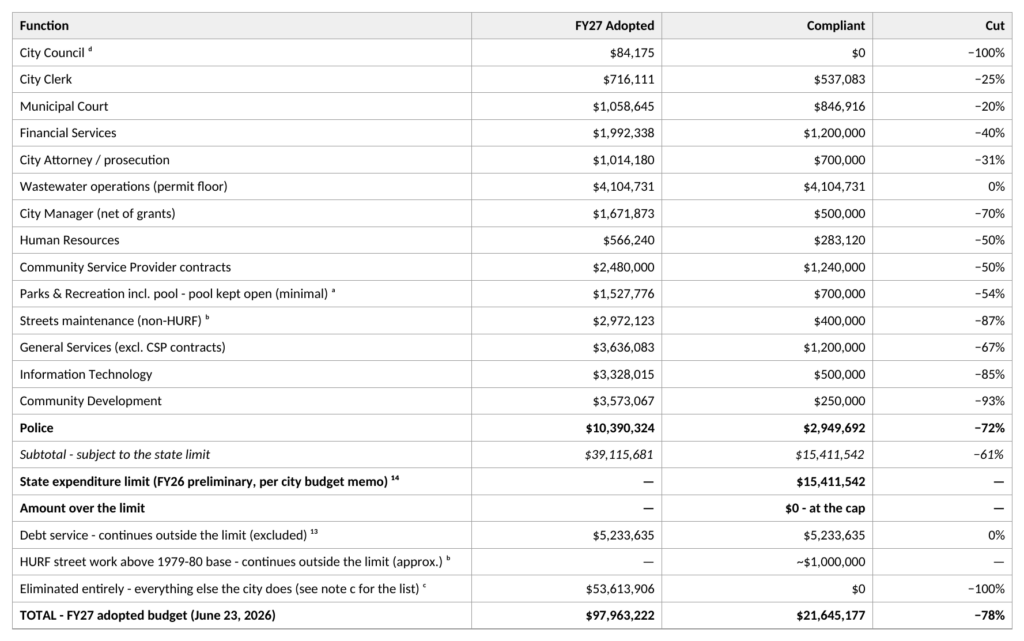
Chart Notes:
a $350,000 for a minimal-hours pool plus $350,000 for minimal parks maintenance – both illustrative estimates, not city numbers. The pool figure of $578,038 is a guess and comes from the Community Idea proposal. It could not be verified and the rows are combined here to avoid double counting.
b The Streets line shows the full Streets Fund adopted budget, which includes the HURF-funded work. In the compliant budget that work continues outside the limit (~$1.0M, shown separately with no Adopted amount to avoid double counting). Total compliant street maintenance is therefore ~$1.4M, a −53% cut overall.
c The eliminated row covers: all grants ($550K), transit ($3.5M), tourism ($2.0M), sustainability ($922K), Public Works beyond streets (~$7.4M), contingency ($5.2M), and all pay-as-you-go capital ($34.0M, including the ADEQ-required injection wells). Small reconciling amounts within these categories are approximate; the row is derived so the Adopted column sums exactly to the full adopted budget.
d Council stipends and expenses zeroed for illustration. This is largely symbolic (0.5% of the cap) and the council itself cannot actually be abolished – an incorporated city must have a governing body (A.R.S. Title 9) – so some minimal cost would persist in practice.
The technical notes above are the fine print. The chart is the story: this is what compliance costs.
Footnotes
- The 2022 voter approval of Home Rule covers four fiscal years, through FY2026-27. If Home Rule is not renewed at the July 2026 election, the state-imposed limit would first apply to the FY2027-28 budget, with that year’s figure set by the Economic Estimates Commission. A one-time override or permanent base adjustment would also require voter approval at a subsequent election.
- An incorporated Arizona city must have a governing body (A.R.S. Title 9).
- City clerk is a required statutory officer; the office also carries mandatory duties for elections (A.R.S. Title 16) and public records (A.R.S. Title 39).
- Every incorporated city or town must maintain a municipal court (A.R.S. § 22-402).
- State law requires an annual independent audit (A.R.S. § 9-481), adoption of a budget under Title 42, Chapter 17, and uniform expenditure reporting to the Auditor General (A.R.S. § 41-1279.07).
- Prosecution of city code violations and misdemeanors is a mandatory function; the in-house office itself could in theory be contracted out, but the duty cannot be eliminated.
- Payment of debt service is a contractual and constitutional obligation; default is not a lawful option.
- Once a city operates a wastewater system, continued operation in compliance with ADEQ permits is legally required. Amount shown is operations only and excludes the $9.2M in permit-driven capital work (injection wells) budgeted for FY27.
- No state statute requires a city to maintain its own police department (law enforcement otherwise defaults to the county sheriff), but continuous law enforcement must be provided in some form.
- Highway User Revenue Fund (HURF) money is legally restricted to street purposes; ongoing street maintenance is a practical and liability-driven obligation rather than a statutory mandate.
- State law requires the city to adopt and administer a general plan (A.R.S. § 9-461.05); administering the adopted Land Development Code is obligatory, though service levels are discretionary.
- The Community Service Provider contracts are budgeted within the General Services department. To avoid double counting, the General Services line shown here excludes the $2,480,000 in contracts, which appear separately under Community programs.
- The Arizona Constitution (Art. IX, § 20) excludes certain expenditures from the limitation, principally debt service on bonded indebtedness and other lawful long-term obligations, expenditures of federal funds, HURF spending above the city’s 1979-80 level, and private grants and donations. Local sales tax, bed tax, state-shared revenues, and wastewater user fees are NOT excluded. The debt service exclusion shown assumes all city debt qualifies; the HURF exclusion is approximate. The city’s Annual Expenditure Limitation Report (AELR) filed with the Auditor General is the authoritative source for exact exclusion treatment.
- State-imposed expenditure limitation calculated under Article IX, § 20 of the Arizona Constitution, as stated in the city’s FY26 budget memo (preliminary figure: $15,411,542). The FY27/FY28 figure from the Economic Estimates Commission will differ modestly with population and inflation adjustments. Under Home Rule, the limit instead equals the adopted budget.
- Skinnier Chicken amounts are the FY27 adopted figures cut in half, rounded to whole dollars (with rounding set so each subtotal equals half the adopted subtotal); Community programs are kept at full adopted amounts. The exclusions are likewise halved.
Source: City of Sedona FY2026-27 Adopted Budget, Official Budget Forms (adopted June 23, 2026); Community Service Provider contracts per April 22-23, 2026 Council budget work session.